


Attack Surface Management

ASM Isn’t Asset Inventory.
It’s Internet Visibility.

Most ASM tools infer your attack surface from DNS records and stale, external signals.
Censys continuously maps your exposure across all 65,535 ports to show you what attackers actually see.

Trusted By

SanDisk logo with the brand name in bold, stylized black letters.
Censys Domino's logo features a tilted square with two dots and the brand name in bold text.
A shield with a white cross and the words "Schweizer Armee" in German, French, Italian, and Romansh.
T-Mobile logo with a magenta "T" and the word "Mobile" in black text.
The Walmart logo features the word "Walmart" with a spark symbol to the right.
Bank of America logo with the bank's name in dark blue and a stylized flag symbol to the right.
Rockwell Automation logo featuring a stylized octagonal icon with the letters "RA" beside the company name in dark teal text.
The Censys Bloomberg logo features the word "Bloomberg" in bold, dark blue text on a white background.
PepsiCo logo featuring a globe icon above the bold, uppercase "PEPSICO" text.
AT&T logo featuring a globe with horizontal stripes and the company name in bold letters.
The Raytheon logo features the company name in bold, dark blue letters with a stylized red and blue arrow symbol.
Merck logo featuring a stylized cluster of circles next to the word "MERCK" in bold uppercase letters.
Censys Evotec logo features a dark teal circle with two smaller circles and the word "evotec" beside it.

Why Exposure Management Teams Choose Censys

How Censys ASM Fits Into Your Security Operations

Discover what others miss

Use Censys’ first-party scanning to find Internet-exposed assets, including services on nonstandard ports, self-signed certificates, hosts in residential networks, and dangling DNS records. Your inventory reflects what attackers can actually reach.

See deep details on web assets

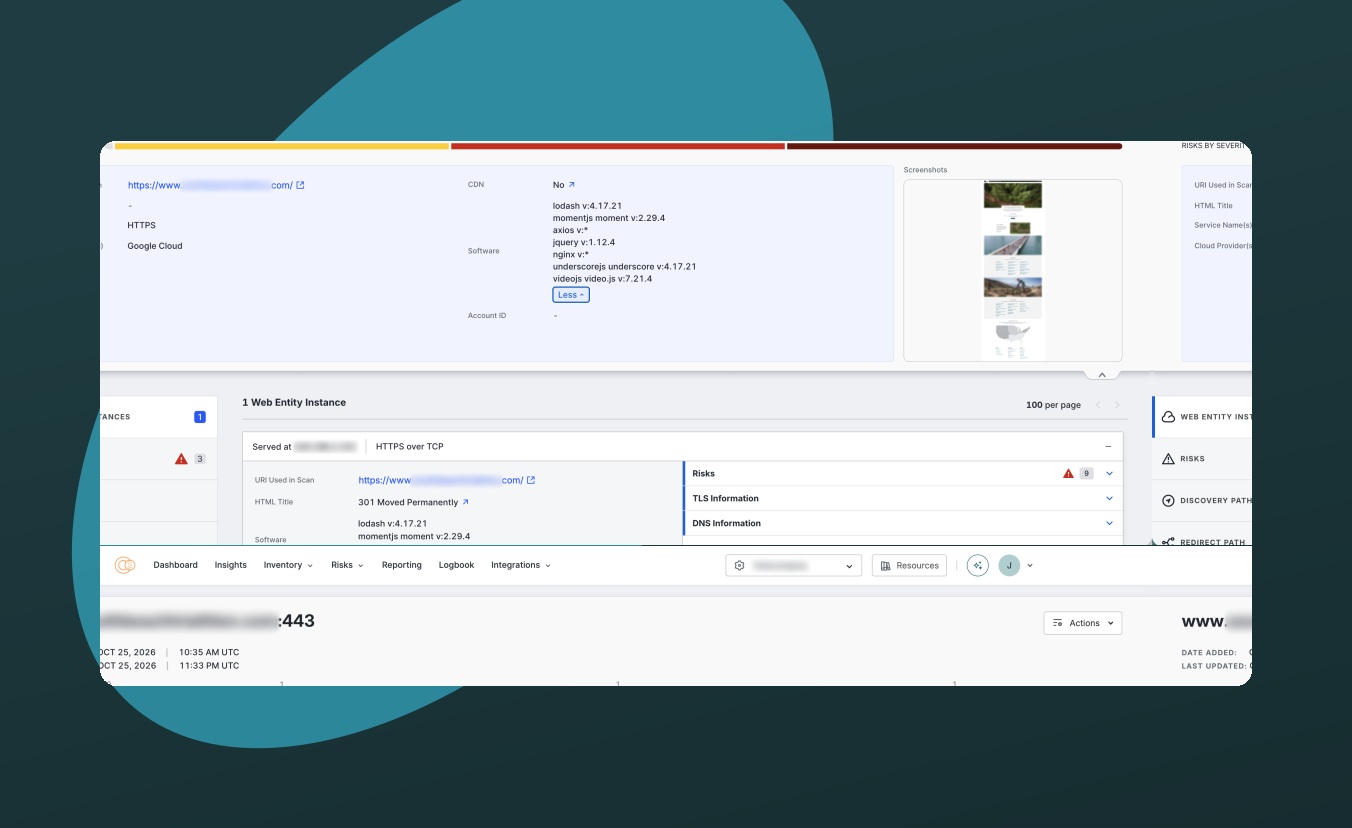
Censys maps the JavaScript libraries, web technologies, and plugins running across your environment, then detects and flags the vulnerabilities and risks present. Screenshots of rendered webpages and full redirect chains give your team the context to remediate issues and shrink your attack surface.

Act on ARC Rapid Response

When Censys ARC flags a new critical exposure or active exploitation, you can confirm reachability in seconds and identify every affected Internet-facing asset, so your team knows where to respond first.

Detect exposure drift immediately

Monitor your surface continuously and get alerted on meaningful changes like new hosts and services, open ports, and reissued certificates to eliminate shadow IT blind spots and accelerate incident response.

Push findings into remediation workflows

Censys ranks risks by severity, category, and affected asset, so your team can act on what’s most critical. Integrate with your ticketing, SIEM, vulnerability management, or other tooling to auto-create, route, and track remediation tasks.

Get answers and audit-ready reporting

Ask the Censys Assistant plain-language questions about your inventory, like which CVEs affect you or which cloud providers are in use, and generate executive-ready reports on demand. Views track exposure trends and remediation progress over time, so you can show risk reduction backed by evidence.

Internet-wide threat investigation

When ASM finds a risky exposure, your threat hunters can pivot straight into Censys Platform to investigate the broader threat: identify likely adversaries, track reused certificates and domains, and map the campaign behind it.

Discover what others miss

Use Censys’ first-party scanning to find Internet-exposed assets, including services on non-standard ports, self-signed certificates, hosts in residential networks, and dangling DNS records. Your inventory reflects what attackers can actually reach.

See deep details on web assets

Censys maps the JavaScript libraries, web technologies, and plugins running across your environment, then detects and flags the vulnerabilities and risks present. Screenshots of rendered webpages and full redirect chains give your team the context  to remediate issues and shrink your attack surface.

Act on ARC Rapid Response

When Censys ARC flags a new critical exposure or active exploitation, you can confirm reachability in seconds and identify every affected Internet-facing asset, so your team knows where to respond first.

Detect exposure drift early

Monitor your surface continuously and get alerted on meaningful changes like new hosts and services, open ports, and reissued certificates to eliminate shadow IT blind spots and accelerate incident response.

Push findings into remediation workflows

Censys ranks risks by severity, category, and affected asset, so your team can act on what is most critical. Integrate with your ticketing, SIEM, vulnerability management, or other tooling to auto-create, route, and track remediation tasks.

Get answers and audit-ready reporting

Ask the Censys Assistant plain-language questions about your inventory, like which CVEs affect you or which cloud providers are in use, and generate executive-ready reports on demand. Views track exposure trends and remediation progress over time, so you can show risk reduction backed by evidence.

Investigate threats across the internet

When ASM finds a risky exposure, your threat hunters can pivot straight into the Censys Platform to investigate the broader threat: identify likely adversaries, track reused certificates and domains, and map the campaign behind it.

Use Censys’ first-party scanning to find Internet-exposed assets, including services on non-standard ports, self-signed certificates, hosts in residential networks, and dangling DNS records. Your inventory reflects what attackers can actually reach.

Censys maps the JavaScript libraries, web technologies, and plugins running across your environment, then detects and flags the vulnerabilities and risks present. Screenshots of rendered webpages and full redirect chains give your team the context  to remediate issues and shrink your attack surface.

When Censys ARC flags a new critical exposure or active exploitation, you can confirm reachability in seconds and identify every affected Internet-facing asset, so your team knows where to respond first.

Monitor your surface continuously and get alerted on meaningful changes like new hosts and services, open ports, and reissued certificates to eliminate shadow IT blind spots and accelerate incident response.

Censys ranks risks by severity, category, and affected asset, so your team can act on what is most critical. Integrate with your ticketing, SIEM, vulnerability management, or other tooling to auto-create, route, and track remediation tasks.

Ask the Censys Assistant plain-language questions about your inventory, like which CVEs affect you or which cloud providers are in use, and generate executive-ready reports on demand. Views track exposure trends and remediation progress over time, so you can show risk reduction backed by evidence.

When ASM finds a risky exposure, your threat hunters can pivot straight into the Censys Platform to investigate the broader threat: identify likely adversaries, track reused certificates and domains, and map the campaign behind it.

Case Study

Swiss Life Germany

Highlights
  • Gained full clarity of the external attack surface
  • Discovered unknown and forgotten “leftover” Internet assets
  • Segmented asset management across dispersed global divisions
  • Increased efficiency in locating and triaging high-priority risks
Security Operations Manager, Swiss Life Deutschland Operations GmbH

Wolfgang Bauer

“Censys helps us see links between assets and DNS entries or outdated software, but in one screen so we don’t have to search for them.”

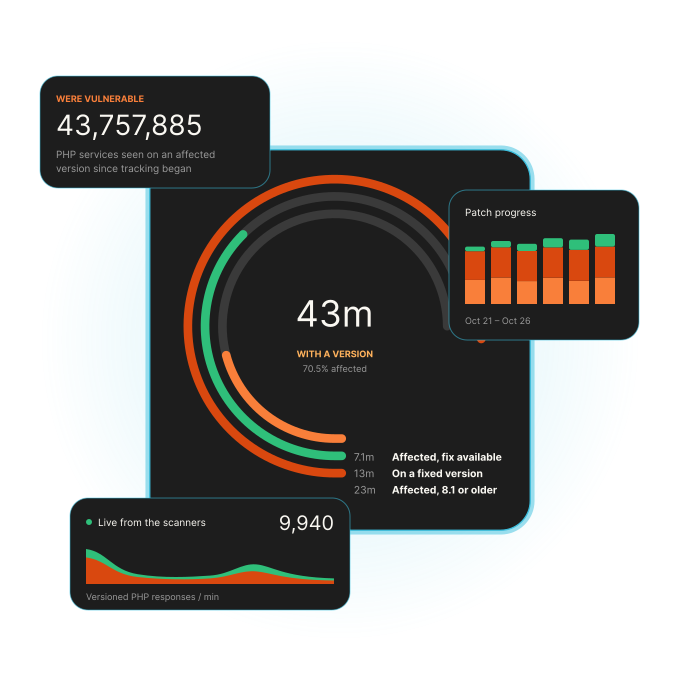
PHP2SHELL EXPOSURE TRACKER

Track global PHP2Shell exposure, updated continuously.