







When you open your company’s website in a browser, you see the finished product: the navigation, the login form, the interactive widgets. It looks complete because your browser did the heavy lifting to build it. But much of what you see, and a lot of what an attacker can reach, isn’t actually in the raw response a server sends back first.
That’s a gap that grows riskier every year. Web properties are some of the most exposed, most attacked layers of your external attack surface. Attacks targeting website vulnerabilities hit 6.29 billion in 2025 – a 56% jump from the 4 billion recorded the year before. This is where your traffic is, and increasingly, where the attacks are too.
That’s the gap Censys ASM’s web scanning is built to close.
How a Modern Website Actually Works
Most sites today run on JavaScript frameworks like React, Angular, Vue, or Next.js. These frameworks don’t serve a finished website; they render the page inside the visitor’s browser after the initial request.
The server’s first response is bare-bones: a small HTML file and a link to a JavaScript bundle. None of the content you would recognize as “the website” is in it. Only after the browser downloads and executes the bundle does the page dynamically assemble itself. This fully assembled, post-execution state is called the Document Object Model (DOM). In addition, a website’s URL might also redirect several times before reaching its final destination. These hops are invisible unless your scanner follows the chain all the way through.
A scanner that sends a single HTTP request is fast, but it only catches that initial, sparse response. Full rendering requires executing the JavaScript, tracing every redirect, and waiting for the DOM to finish building. It takes more computing power, but it is the only way to see what an attacker sees.
What’s New in Censys ASM
Censys ASM now automatically does full page loading and DOM evaluation. Here’s what that enables:
- JavaScript Library, Web Technology, and Plugin Mapping: Censys maps out all the libraries (e.g., jQuery, AngularJS), web technologies, and plugins (e.g., WordPress, Hugo) running across your environment, then detects and flags the vulnerabilities and risks present. You gain immediate visibility into exactly what’s active on every asset, making it easy to identify unapproved or out-of-policy software.
- New Web Risk Detection: We’ve paired this deep web mapping with over 400 new web-specific CVE detections. The moment a vulnerable library or outdated plugin appears, Censys flags it, allowing you to remediate the risk and shrink your attack surface before threat actors can exploit it.
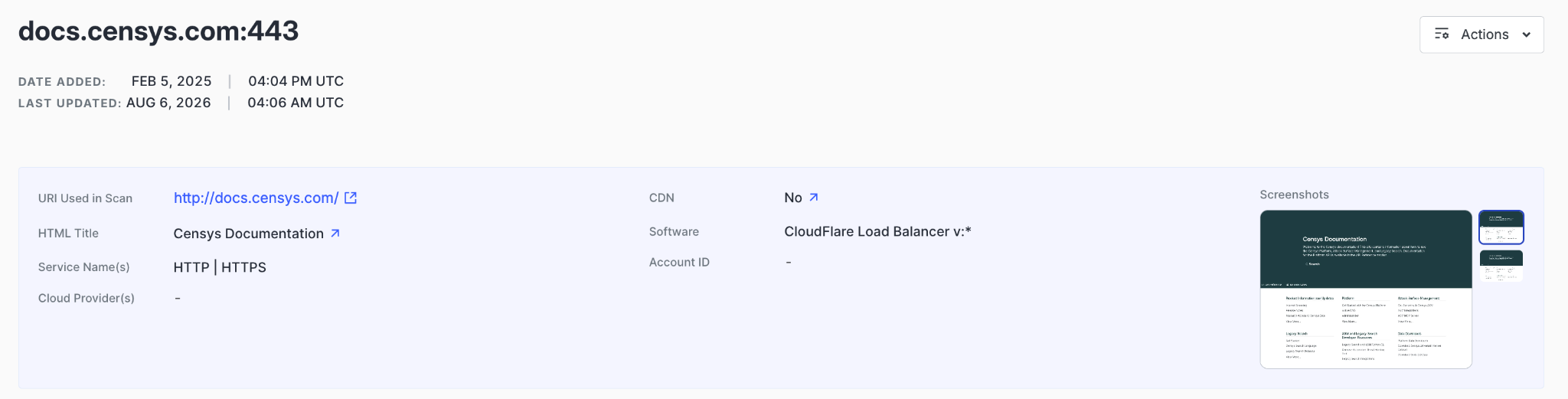
- Web Screenshots: Every web entity in your inventory gets an automatic screenshot within 24 hours of discovery. You can see your entire web footprint and spot defaced pages, 404 errors, exposed admin panels, or unauthorized login forms without opening a single tab.
- Full Redirect Chain: Censys follows every hop a URL takes. If a redirect lands on a hijacked domain or a phishing site, you see the actual final destination rather than guessing from a vague 3xx response.
Built to Fit How You Already Work
Adding vertical depth to your attack surface shouldn’t mean drowning your security team in yet another dashboard to check or new workflow to implement. We designed these features to fit directly into your team’s existing daily workflows.
Instead of clicking into individual web pages or navigating to other tools to see what’s on each webpage, you can now view all the content and risks of your entire web inventory in one place. Errors on web pages, logins that shouldn’t be live, and compromised pages are all visible at a glance.
Because Censys scans these assets continuously, you always have an up-to-date inventory of the web technologies and JavaScript libraries running across your perimeter and the vulnerabilities affecting them. This visibility lets you act proactively on risks, steadily shrinking your attack surface. When a critical web vulnerability does drop, you’re aware of your exposure right away, and can remediate it quickly.
Where Depth Meets Breadth
Web-layer visibility isn’t a brand-new concept. Plenty of exposure management tools are adding some version of screenshots or JavaScript detection, because the underlying problem, modern web apps hiding their real content behind client-side code, is an industry-wide challenge.
The true differentiator comes down to data quality and visibility. While others may claim to see your whole web attack surface, we’re the only ones with the comprehensive, continuous scanning and attribution to prove it.
Ready to See Your True Perimeter?
If you’re already a Censys customer, log into your ASM dashboard. The screenshots, redirect chains, and risk data are already live.
If you’re evaluating ASM solutions, reach out and we’ll show you what Censys ASM uncovers on a real attack surface.