





Executive summary
- ARTEX is an open-source, LLM-driven autonomous penetration testing framework released in July 2026. In October, two threat intelligence companies attributed its use as part of threat actor operations; CrowdStrike linked it to a campaign against South Korean financial institutions, and Microsoft linked it to Storm-0940’s compromise of ConnectWise customer tenants.
- As of November 4, 2026, Censys observed 1,465 hosts running an exposed ARTEX console. About 650 sit in two blocks of identically configured hosting, which leaves roughly 815 distinct-looking deployments. The ARTEX console does not require public-facing access, and overall global deployment is likely higher.
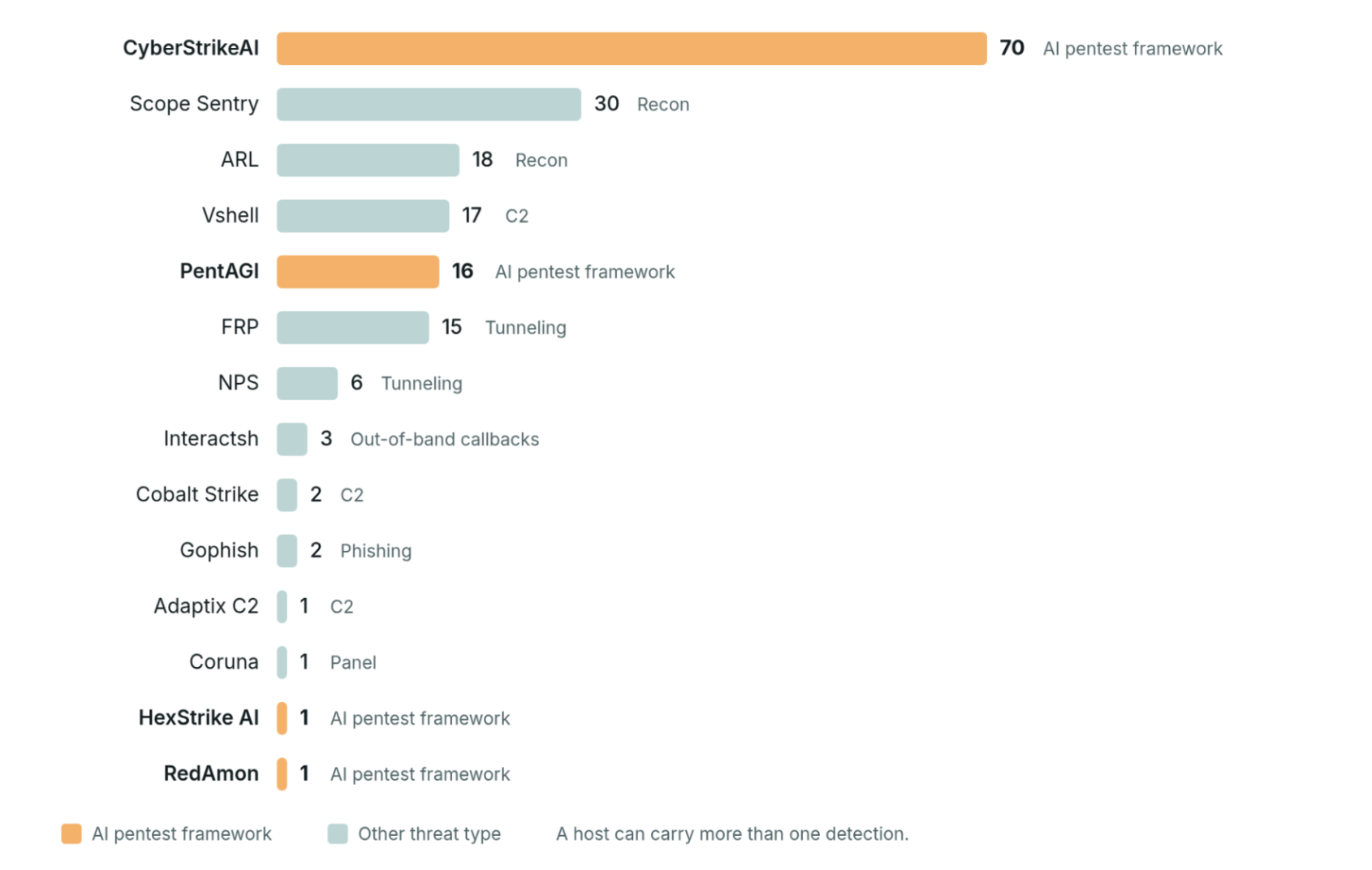
- 155 ARTEX hosts (10.6%) also run at least one other threat that Censys detects. These include other AI attack frameworks, recon platforms, tunneling tools, and C2: Vshell, Cobalt Strike, and Adaptix C2.
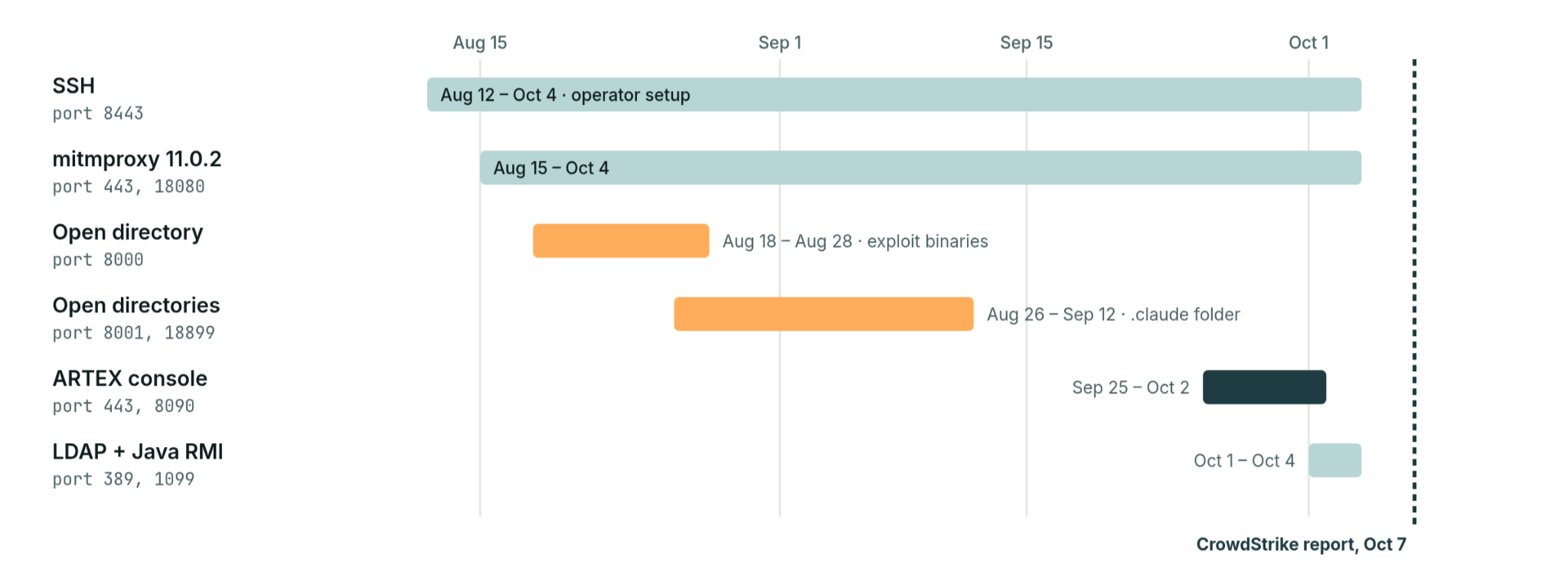
- Censys saw open directories on the ARTEX server named in CrowdStrike’s report starting August 18, 2026, seven weeks before that report was published. The directories exposed exploit binaries and a
.claudefolder. - That mistake is common: 32 open directories run on other ARTEX hosts today, exposing post-exploitation kits, stagers, and implants.
What is ARTEX?
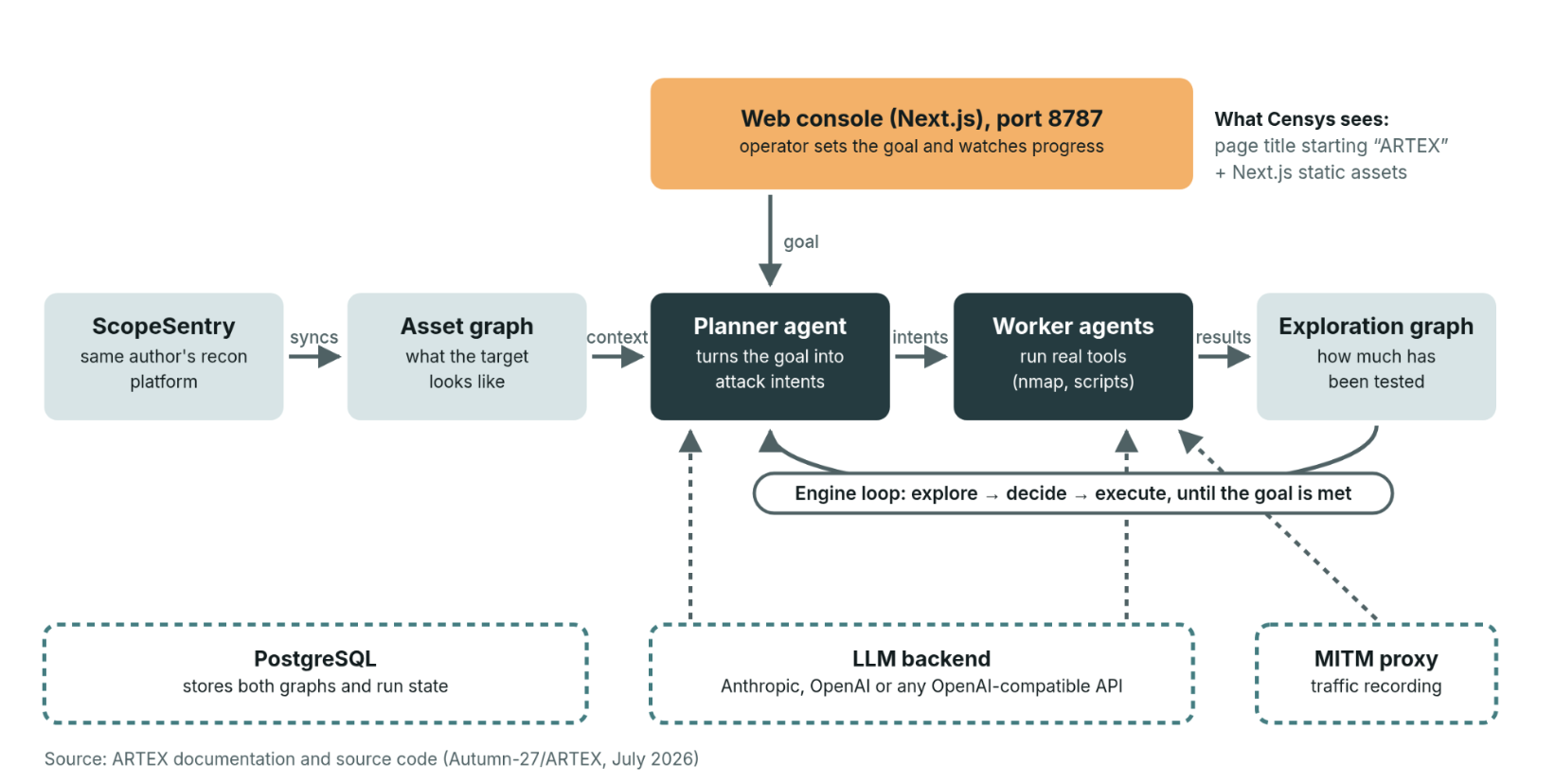
ARTEX was published on GitHub as Autumn-27/ARTEX on July 26, 2026, under the AGPL-3.0 license. Its developer, Autumn-27, is also the author of ScopeSentry, a widely used Chinese asset-discovery and vulnerability-scanning platform with more than 2,000 GitHub stars. ARTEX is best understood as an AI agent layer on top of that recon foundation. It syncs assets found by ScopeSentry’s domains, subdomains, IPs, ports, and endpoints straight into its own asset graph.
Following public release, the project grew quickly, reaching an estimated 1,500-2,000 stars within ten weeks of release. On October 8, the day after CrowdStrike released a report detailing observed malicious usage, the author (Autumn-27) posted a statement on their GitHub profile, claiming they were not involved in the attacks and that ARTEX was meant for testing within authorized asset scopes. Autumn-27 then stated that the project would go closed-source with no further releases. The repository has since been taken down, but archived copies, translations, and rebrands such as ScopeWeaver are still circulating.
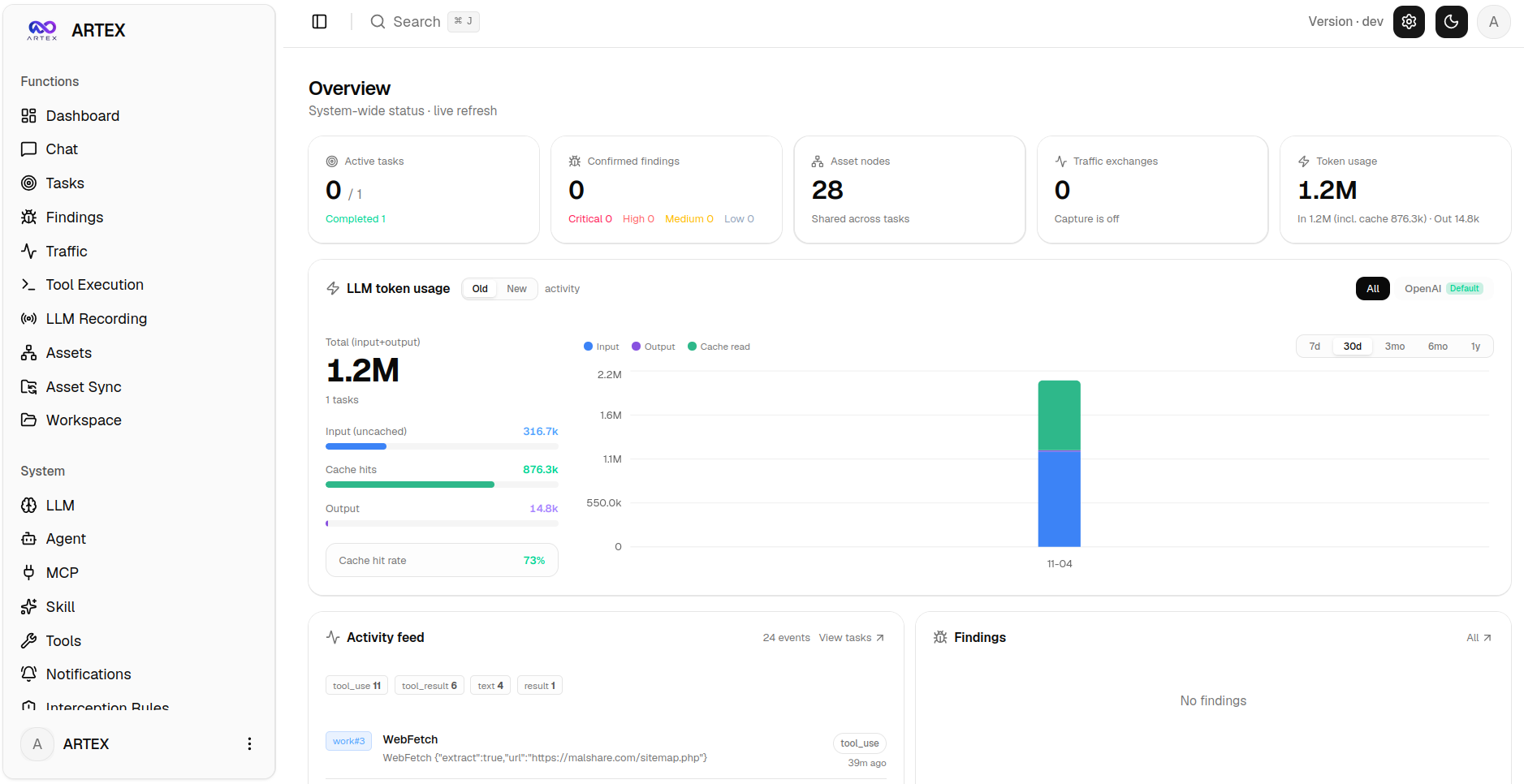
ARTEX is written in Go and uses a Next.js web console, backed by PostgreSQL. ARTEX usage starts with users defining Tasks, which outline the scope, test accounts and goal for agents – the example shown by default is “What to achieve, e.g., gain admin panel access or server privileges”. Running tasks leverages multiple sub-agents for completing the goal.
A Planner agent turns the goal into attack “intents”. Worker agents claim those intents, run tools (e.g., nmap, which ships in the Docker image), and write results back. An event-driven engine repeats that explore-decide-execute loop until the goal is met. ARTEX tracks two graphs: an asset graph of what the target looks like, and an exploration graph of how much of it has been tested. It also includes mitmproxy for traffic recording, and it works with Anthropic, OpenAI, or any OpenAI-compatible model endpoint. Microsoft describes it as able to run “from reconnaissance through data exfiltration” with minimal human input.
The following is a logical diagram of ARTEX’s structure with ScopeSentry running in parallel to manage the Asset graph:
ARTEX in two campaigns
Not every ARTEX instance is operated with malicious intent, and some of the hosts publicly exposed are likely operated by authorized testers. As with all offensive security tools, there exists the potential for malicious usage. Two notable reports were released in October 2026 that provided context into observed malicious usage.
South Korean finance (CrowdStrike, October 7)
On 7 October 2026, CrowdStrike reported that an unattributed actor using ARTEX targeted a South Korean finance company from late September to early October. The actor was assessed with moderate confidence to be a financially motivated Chinese speaker. The actor breached a broker-facing loan inquiry service at one bank and an employee mobile system at another, and exfiltrated data. ARTEX ran on 38.244.50[.]120 with DeepSeek v4.1-flash as its main model, which the actor likely bought through an API reseller. The actor also ran Claude Code sessions backed by GLM and Grok. CrowdStrike found the activity because the actor left open directories exposing a .claude folder, prompts, session histories, and ARTEX configuration files.
CrowdStrike’s report identified an open directory exposed at 38.244.50[.]120:18899. Censys scan history for that host shows how long it had been exposed:
The file names show the actor working on targets well beyond South Korean banks, including payment and gaming services. That fits CrowdStrike’s observation of broader activity tied to the same persona.
The more useful finding for defenders is that this mistake is not unusual. During the writing of this report, Censys observed 32 open directories on ARTEX hosts. Examples:
| Host | Exposed contents |
110.42.215[.]163:18080 | GodPotato, Invoke-TheHash / SMBExec / WMIExec, pass-the-hash scripts, MSSQL UDF DLL: a Windows lateral-movement kit |
111.68.4[.]13:18080 | A public CVE-2021-3156 (sudo “Baron Samedit”) exploit, heap dumps, and brute-force scripts |
108.165.147[.]226:8299 | Three beacon_linux_amd64 implant builds and reverse-shell scripts, on a host that also runs FRP and CyberStrikeAI |
206.187.215[.]173:8081 | c2.py, stager.c, and a compiled Windows stager |
181.41.194[.]136:8081 | About 18 HTA droppers, batch loaders, a wpad.dat, and a MITM root CA private key |
203.195.243[.]103:80 | The fscan internal scanner and payload executables, next to a Vshell listener |
154.12.86[.]207:18080 | An operator’s entire home directory, including .ssh, .bash_history, and the ARTEX install |
Most of these directories were only active for hours to a couple of days. Between November 3 and November 5, 10 closed and 15 new ones appeared on other ARTEX hosts. Because Censys keeps scan history, the file listings remain available after the operator takes the directory down.
Storm-0940 and ConnectWise (Microsoft, October 21)
Microsoft attributed the ConnectWise Cloud Backup supply-chain compromise to Storm-0940, a China state-aligned actor active since 2021. The group used ARTEX to automate scanning, password spraying, and OAuth application abuse. It attempted sign-ins to more than 2,250 tenants, peaking at 2,900 attempts per minute, and some victims saw privileged cloud access in under three hours. Microsoft also notes it has seen multiple actors across regions using ARTEX.
Censys ARC Perspective
Censys detects ARTEX consoles by their page title (localized versions start with “ARTEX” followed by a space, colon, or dash) together with Next.js static assets. Censys Platform users can see them under the threat label ARTEX for hosts and web properties.
(web.endpoints.http.html_title=~"^ARTEX[ :—]" and web.endpoints.http.body: "_next/static" ) or (host.services.endpoints.http.html_title =~ "^ARTEX[ :—]" and host.services.endpoints.http.body: "_next/static")
As of November 3, 2026, this matches 1,465 hosts.
| Measurement | Observed |
| Most common console port | 8787, the ARTEX default (1,931 endpoints), then 8790, 443, 80 |
| Top countries | United States – 726 Hong Kong – 387China – 177Japan – 51Singapore – 38South Korea – 21 |
| Console language | The Chinese default dominates. English, Korean, Japanese, Russian, and Portuguese localizations also appear |
Two hosting netblocks account for about 44% of hosts and merit further analysis:
- PEG Tech (AS54600): 493 hosts. They share one of two identical port layouts across 13 /24 networks. 125 hosts each sit in
38.11.221[.]0/24and38.11.173[.]0/24. - Yancy Limited (AS138415): 157 hosts. They share an identical CyberPanel-plus-mail-server template, mostly in
156.234.0[.]0/16.
Uniform configurations like these suggest a provisioning template rather than hundreds of individual operators. Excluding them leaves about 815 ARTEX deployments. Yancy Limited and Zenixcloud (22 ARTEX hosts) also hosted proxy IPs listed in CrowdStrike’s report.
Yancy Limited (AS138415) has come up in Censys reporting before. In December 2025, we observed a surge of Cobalt Strike listeners, mostly on Yancy, that peaked at 407 new hosts in a day and dropped to zero within two weeks. We assessed them as likely “a couple of unique instances spread across hundreds of IP aliases.” The Yancy ARTEX hosts follow the same pattern: one server template repeated across many addresses. The full details connection between the two remains unclear, but in both cases a large host count likely comes down to a few real servers.
We also see customized builds: ARTEX MX on four adjacent hosts at 104.250.149[.]210 – 104.250.149[.]210, plus ARTEX v2 · Agent Security Workbench and a handful of other renamed consoles.
What else runs on ARTEX hosts
Of the 1,465 ARTEX hosts, 155 (10.6%) carry at least one other Censys threat detection.
Three patterns stand out.
Operators stack AI attack frameworks. The most common companion to ARTEX is another AI pentesting tool. CyberStrikeAI shares hosts with ARTEX on 70 hosts, and PentAGI, HexStrike AI, and RedAmon also appear. Operators appear to be using multiple agent frameworks side by side.
AI tooling sits next to conventional C2. A small but clear set of hosts pairs ARTEX with established command-and-control and tunneling tools:
1.14.104[.]208: ARTEX and PentAGI, alongside a Cobalt Strike teamserver on port 50050 and an Adaptix C2 listener on 4321.1.14.193[.]53: two ARTEX consoles, Vshell, NPS, Gophish, a mail server admin panel, and a page titled “SuperAgent 主监督” (“SuperAgent main supervisor”).101.42.4[.]91: an ARTEX console on 443 and a Vshell login on 18080192.210.193[.]156: ARTEX with two Vshell listeners and an FRP server.45.87.53[.]3,45.87.53[.]4,45.87.53[.]6,45.87.53[.]10,45.87.53[.]14: five identically configured hosts, each running ARTEX, CyberStrikeAI, ARL(Asset Reconnaissance Lighthouse), and Vshell. Likely this is either a device with multiple public IPs on the same subnet or a cloned image.
LLM access is part of the tech stack. 43 ARTEX hosts also run self-hosted LLM gateway or reseller software, mainly CLIProxyAPI (19) and New API (18). The actor in CrowdStrike’s report bought DeepSeek access through a reseller. For defenders, unfamiliar LLM proxies and resellers in egress logs are worth investigating.
Hunting ARTEX with Censys
- Console: the query above, or the ARTEX / ScopeWeaver threat labels in the Censys Platform.
- Default port: 8787/tcp, with 8790 and 443 common.
- Pivots: look for co-located open directories, Vshell or FRP listeners, and LLM proxy software (CLIProxyAPI, New API) on the same host.
- History: check scan history for mitmproxy banners and short-lived Python
SimpleHTTPservers on high ports. They often appear before the console does.
Indicators
Reported by CrowdStrike and Microsoft:
| Indicators | Context |
38.244.50[.]120 | ARTEX host and open directory (CrowdStrike) |
101.53.80[.]20205.214.59[.]31124.155.252[.]63154.201.79[.]24623.248.249[.]9023.158.220[.]98103.248.148[.]84203.160.133[.]172209.209.85[.]38 | Proxies (CrowdStrike) |
xcai[.]pro | LLM API reseller (CrowdStrike) |
144.172.64[.]60144.172.64[.]99144.172.64[.]128 | Storm-0940 infrastructure (Microsoft) |
Censys-observed hosts referenced in this post:
1.14.104[.]208
1.14.193[.]53
101.42.4[.]91
192.210.193[.]156
45.87.53[.]3
45.87.53[.]4
45.87.53[.]6
45.87.53[.]10
45.87.53[.]14
104.250.149[.]210
104.250.149[.]211
104.250.149[.]212
104.250.149[.]213
110.42.215[.]163
111.68.4[.]13
108.165.147[.]226
206.187.215[.]173
181.41.194[.]136
203.195.243[.]103
154.12.86[.]207
References
- CrowdStrike, Unknown Threat Actor Uses AI-Driven ARTEX to Target South Korean Finance
- Microsoft Threat Intelligence, AI-driven, large-scale nation-state campaign using ARTEX enables supply chain compromise
- BleepingComputer, Hacker used ARTEX AI and Claude agents to target South Korean banks
- Autumn-27 GitHub profile and ARTEX statement
- ScopeSentry
- Zendot, ARTEX: A Self-Hosted Autonomous Penetration Testing System Written in Go