





Executive summary
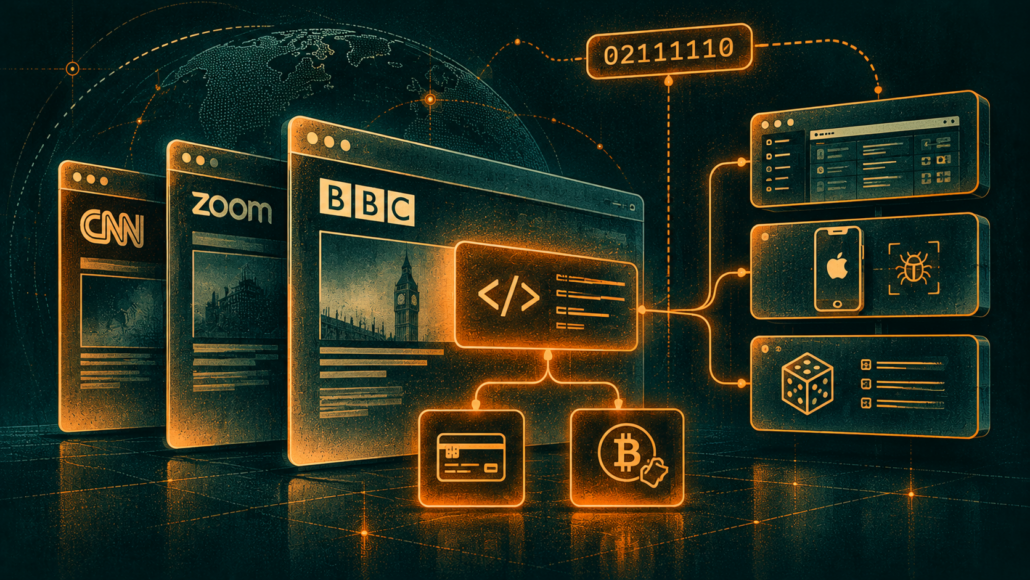
- On November 16, 2026, poisoned third-party scripts delivered a card skimmer and a cryptocurrency clipper to visitors of major websites, including the BBC, Zoom, and CNN.
- Censys linked the campaign’s infrastructure to a related cluster: a control panel titled MCH 管控平台, an iOS exploit backend branded 财神 (Caishen), and cryptocurrency “energy rental” storefronts.
- As of November 17, 2026, Censys observed the panel title on 142 web properties, the Caishen backend title on 144, and the storefront title on 55. These counts cover multiple deployment versions.
- Optimizely’s status page states that an unauthorized party exploited a vulnerability in its Experimentation product to add malicious JavaScript to some customer projects, and that the vulnerability is fixed, the injected code removed, and the affected accounts secured. Reporting ties the same loader to other third-party libraries, including Kissmetrics, StorifyMe, and minute-ly.
- Both staging hosts and the implant C2 host went offline on November 17, 2026, within hours of disclosure. Within about a day, the operator had five new MCH panel hosts live on NETSEC-HK (AS45753), and the kit vendor re-listed the package on GitHub.
- The channel code
02111110shared by the loader and skimmer is the kit’s hard-coded default: it links the campaign’s components to one control panel, but identifies no specific operator, and over a hundred deployments of this kit carry it. - Staging started on November 9, 2026, a week before the theft. Tron and Ethereum proceeds moved through commercial services within hours of receipt.
What happened on November 16?
Following reports about malware spreading through popular websites, Censys noticed visitor browsers contacting multiple recently registered domains. To observe who reached those domains and what they collected, Censys sinkholed them starting on November 16, 2026. Hudson Rock provided the first report on this campaign of malicious code being delivered by multiple third-party libraries, Optimizely among them. Amirul Cyber tracked the same injection as OPTIMJACK. Based on referrers to our sinkholing, we can confirm the reported impacted sites include BBC, Zoom, CNN, DoorDash, Zillow, Fox News, and GitLab. The malicious code delivered by these sites uses a known iOS exploitation toolkit – Caishen, to deliver subsequent payloads related to Coruna and Darksword. Visitors on phones and tablets get the exploit chain. Visitors on desktop systems get a card skimmer, a cryptocurrency clipper, and page-data theft instead.
The injected code arrives through embedded third-party scripts. For example, on zoom[.]com, Censys captured an Optimizely script at cdn.optimizely[.]com loading a JavaScript file – track.js from the domain 1688360[.]cc, which starts the exploitation chain. Censys deep web scanning records show the same track.js javascript on at least 30 sites as of November 16.
Optimizely addressed the injection on its status page at 01:02 UTC on November 17, 2026. The company stated that an unauthorized party exploited a vulnerability in its Experimentation product to add malicious JavaScript to some customer projects, and that it has fixed the vulnerability, removed the injected code, and secured the affected accounts. That statement covers one delivery vendor. Reporting and Censys data tie the same loader route to other third-party libraries, including Kissmetrics on November 13, StorifyMe, and minute-ly.
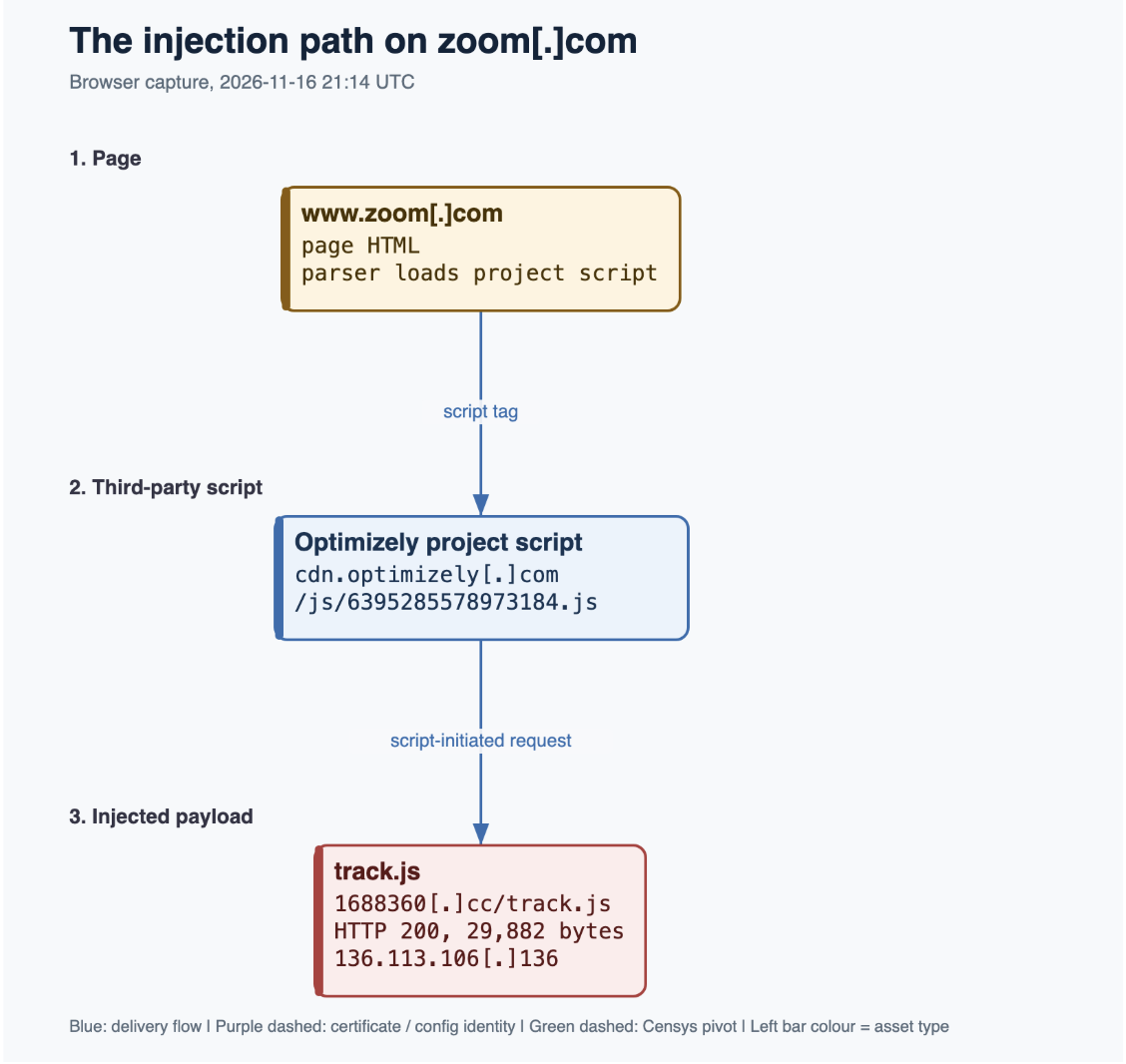
Figure 1: The Optimizely project script loading track.js from 1688360[.]cc
The 29 KB track.js payload combines four mechanisms:
- Card skimmer. track.js runs on every page the script loads, not only at checkout. It hooks form submissions and input fields, collects anything that looks like a card number, expiry, or CVV, and validates the number with a Luhn check, before sending it with the page URL to
/card.php. On a site likezoom[.]com, the fields exist only on payment pages, so a visitor’s card is captured when a payment form on that site is submitted. - Cryptocurrency clipper. The script replaces any copied cryptocurrency addresses in a user’s clipboard with eight hardcoded wallets, one per chain: Ethereum, Bitcoin, Litecoin, Bitcoin Cash, Tron, TON, Solana, and Dogecoin.
- Page-data exfiltration. The script posts the page URL, up to 8,000 characters of cookies, and a picture of the page as the visitor’s browser renders it, taken with a browser-side screenshot library, to
/hit.php. Both exfiltration endpoints live on the same1688360[.]cchost that serves track.js. - iOS staging. On iPhone, iPad, and touch-screen Mac user agents, the script loads boot.js from two payload domains. On iOS 18.6 and earlier, it also embeds a hidden iframe that loads a page from
eil786npto9u5bq[.]icu. - Non-iOS visitors. Everyone else just gets the card skimmer, clipper, and page-data exfiltration. The exploit chain never loads.
The same iOS loader also reached pages by a second route that skips the skimmer. A 400-byte script at webshell[.]lol/get.js adds a script tag pointing at 5vobauua3ojpklx[.]icu/boot.js to any page that runs it. The script has no device check, so every browser that loads the page fetches boot.js. Both the skimmer and this loader set the channel code 02111110 on the script tag they add.
Timeline
Censys scan history, certificate records, and public blockchain records date the operation. All times are UTC.
| Date | Event |
| April 3, 2024 | The loader domain webshell[.]lol is registered. |
| November 9, 2026 | The first payload server, 34.96.213[.]201, appears in Censys scan history with three .icu domains on one certificate. |
| November 12, 2026 | The campaign’s Ethereum wallet receives its first seed payment. |
| November 13, 2026 | Page scans record boot.js served from 5vobauua3ojpklx[.]icu and the loader running on third-party pages. |
| November 14, 2026 | A second staging server, 34.124.226[.]157, appears with five domains in the same random-character style as the first server’s. It shares an SSH banner hash and a metrics service on port 20201 with the first. |
| November 16, 2026, 05:04 | A certificate is issued for the delivery domain 1688360[.]cc. |
| November 16, 2026, 08:25 | The first page scan records an affected site loading the delivery domain. Wallet receipts start at 10:31. |
| November 16, 2026, 13:05 | 546.8 USDT, a dollar-pegged stablecoin, moves from the Tron wallet to a high-volume aggregator address. |
| November 16, 2026, 21:14 | A Censys capture of zoom[.]com still loads track.js. A capture of bbc[.]com at 21:22 contacts no campaign domain. |
| November 17, 2026, 01:02 | Optimizely publishes its statement on the Experimentation vulnerability. |
| November 17, 2026, 03:30-05:22 | The campaign’s two staging hosts and the implant C2 host go offline. |
| November 17, 2026, 04:11-04:13 | The Litecoin and Tron wallets are swept to the operator’s recurring destination. |
The collection endpoint /hit.php still answered with HTTP 204 at about 21:55 on November 16, 2026.
The campaign’s infrastructure did not last long past disclosure. Both staging hosts and the implant C2 host went offline between 03:30 and 05:22 UTC on November 17, 2026. Within about 24 hours, a block of five new MCH panel hosts running build DRYPnrzh went live on NETSEC-HK (AS45753). The kit vendor re-listed DarkSword-27.1 packages on GitHub the next morning under a new Telegram contact, t.me/h8e888. The Litecoin wallet was swept at 04:11 UTC and the Tron wallet at 04:13 UTC to the operator’s recurring TMLQ destination, matching the historical sweep cadence. The Bitcoin wallet was untouched.
Censys ARC perspective
This is how Censys ARC sees the campaign, based on our scan data. Rather than developing bespoke tooling for this campaign, the operator used existing infrastructure. The loader was likely rented, and the iPhone exploit kit matches a public dump. The control panel is a product that other servers also run. Figure 2 shows each piece and how a visitor moves through them.
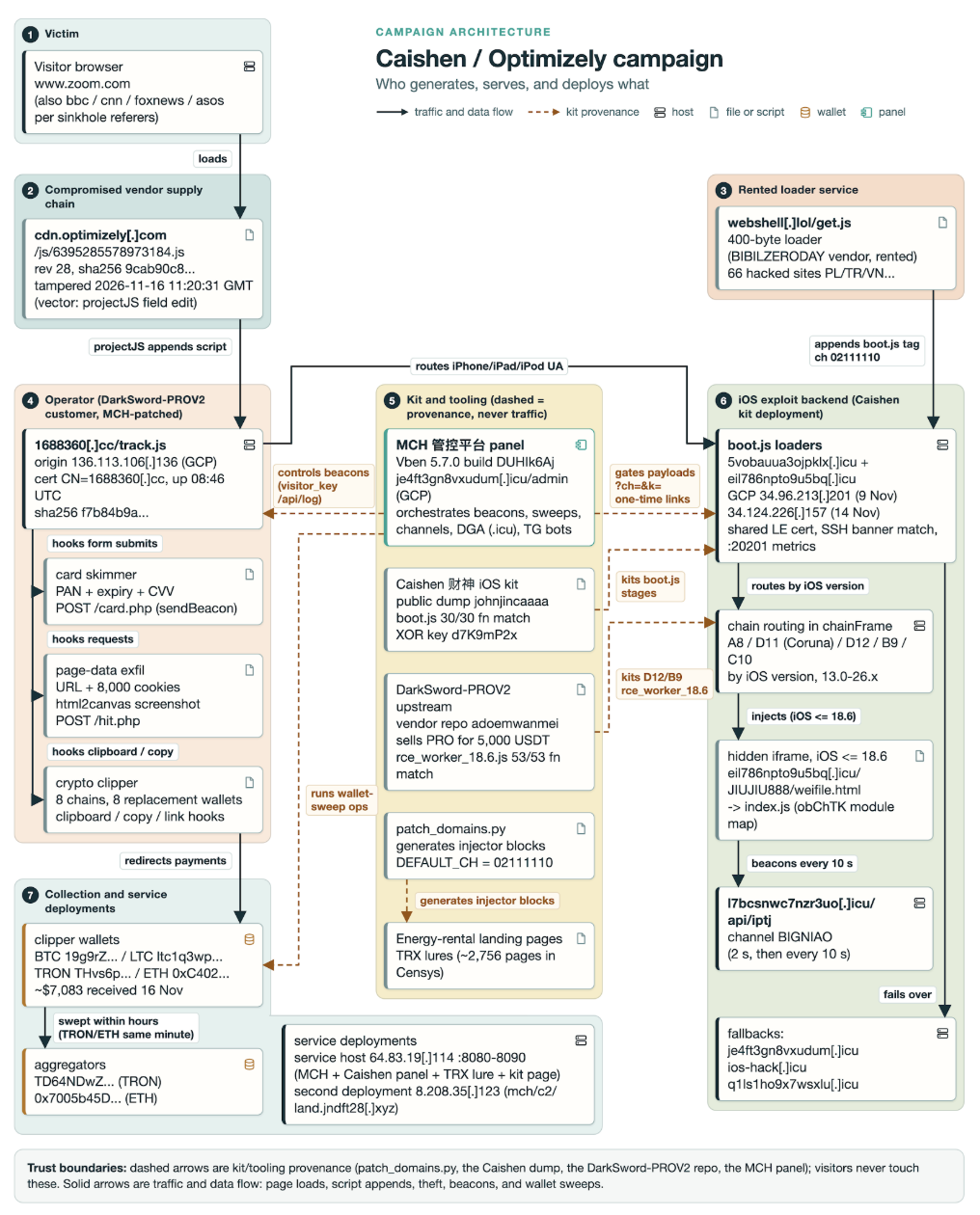
Figure 2: Campaign architecture, showing who generates, serves, and deploys what
The campaign’s first payload server, 34.96.213[.]201, presents one certificate for three random-string .icu domains. One of them, 5vobauua3ojpklx[.]icu, served the iOS stage loader. A second domain, je4ft3gn8vxudum[.]icu, serves an administrative interface at /admin/ titled MCH 管控平台, which translates to “MCH control platform”.
The service host
The same panel title appears on 64.83.19[.]114, a host in Los Angeles on AS979. We tie it to this campaign by its kit configuration rather than by the title alone: the host’s pages carry the same channel code 02111110 and the same energy-rental config hash as the campaign’s service deployments, and it exposes the whole stack on adjacent ports:
| Port | Observed |
| 8080 | MCH 管控平台 control panel at /admin/ |
| 8081 | 财神iOS漏洞后台, “Caishen iOS exploit backend”, a Vben Admin 5.8.0 build with a Baidu analytics counter |
| 8082 | A TRX energy-rental storefront |
| 8083 | An unlisted page with a module-map stage loader |
| 8090 | An energy-rental landing page with an injector block that loads boot.js from port 8001 |
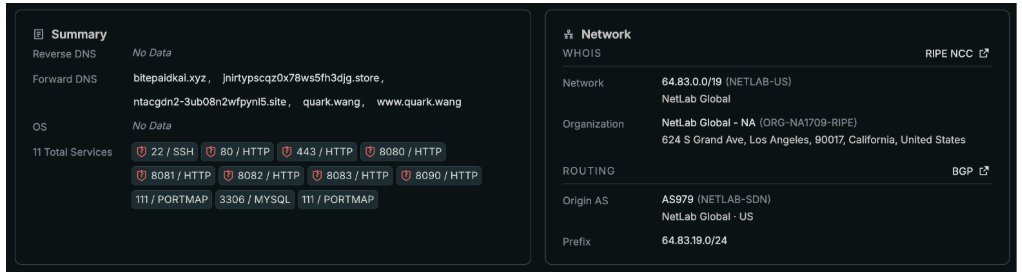
Figure 3: Services on 64.83.19[.]114
A second deployment runs on 8.208.35[.]123, an Alibaba Cloud host in London. It serves the same landing page and injector block. Its hostnames follow a role scheme: mch.jndft28[.]xyz, c2.jndft28[.]xyz, land.jndft28[.]xyz, and api.o45qhw6g17bwhdy[.]icu.
The MCH panel appears in two places. On the service host, it runs next to the exploit backend, the storefronts, and the stage loader. On the campaign server, 34.96.213[.]201, it shares a certificate with the domain that served the iOS loader. Based on that overlap, Censys ARC assesses with moderate confidence that operators use the panel to manage these deployments.
The generator and the default channel code
Both landing pages carry the same injector block. Its comment names the tool that built it:
// 引流配置 – 由 patch_domains.py 生成
The comment translates to “traffic-diversion config, generated by patch_domains.py”. The block sets DEFAULT_CH = '02111110'. It reads a per-source code from the ch, channelCode, channel, or c URL parameter, and falls back to the default. The campaign’s loader and skimmer carry that default. Any deployment that sets no per-source code carries it too, so a match does not identify the operator.
The campaign’s payload domains, the staging siblings, and names on both service deployments are random 15-character .icu domains. Censys ARC assesses with moderate confidence that the same tooling generated them.
The stage loader on port 8083
Port 8083 on the service host serves an unlisted page. Its inline script decodes a Base64 module map, installs a global dispatcher, and fetches content-hashed stage files by URL. Hudson Rock describes the same dispatch structure on the campaign’s delivery pages, where it loaded stages routed by iOS version.
Deployed base
Censys Platform users can find each tier by page title:
web.endpoints.http.html_title=”MCH 管控平台”
web.endpoints.http.html_title=”财神iOS漏洞后台”
web.endpoints.http.html_title=”能量租赁 – 24小时无人值守极速到账”
As of November 17, 2026:
| Measurement | Observed |
| MCH control panel title | 142 web properties |
| Panel body, byte-identical | 19 web properties share one body hash |
| Panel version string | mch-v5-5.7.0-prod |
| Caishen iOS exploit backend title | 144 web properties |
| Cryptocurrency “energy rental” storefronts title | 55 web properties |
The matching properties span unrelated hosting providers and registrants. A shared version string indicates one release deployed by many operators. The November campaign accounts for three hosts and their domains, listed under Indicators.
Wallet activity
Public blockchain records show no activity on the Ethereum wallet before November 12:
- Ethereum: a 0.0192 ETH seed on November 12. 4,310.82 USDC left by direct transfer on November 16, after the wallet approved the amount to a swap contract earlier that day.
- Tron: 50 lifetime transactions; 10 on 16 November beginning 10:31 UTC. 546.8 USDT moved to an aggregator address at 13:05.
- Bitcoin: five payments on November 16, totaling 0.0853 BTC. Unspent at 22:00.
- Litecoin: three payments on November 16, totaling 17.02 LTC. Unspent at 22:00.
- Dogecoin: no activity.
- Bitcoin Cash, Solana, and TON: no activity observed.
The Ethereum funding address and the Tron aggregator each handle thousands of transfers a day, which indicates commercial services.
The energy-rental kit publishes its own Tron deposit address. That address matches none of the campaign’s wallets.
The loader vendor
The loader domain webshell[.]lol predates the campaign by two years. Its root page advertises webshells and black-hat SEO services under the handle BIBILZERODAY . The handle’s Telegram channel has 13 subscribers and one substantive post. That post, dated November 9, moves customer contact to the Session messenger. The first payload server appeared in Censys scan history the same day.
Censys ARC assesses with moderate confidence that the campaign operator rented the loader from this vendor. The evidence does not show that the vendor and operator are the same person.
Hunting MCH and Caishen with Censys
- Panel: the MCH title query. The same title appears across deployments with different generated domains.
- Exploit backend and storefronts: the two title queries above.
- Page content: the strings
patch_domainsand引流配置in a served page mark the generator. - Channel code: data-channel-code=”02111110″ on a script tag marks the kit’s default configuration.
- Domain pattern: random 15-character .icu names that serve boot.js.
- Containment: to remove the injection, remove the injected project code. Hudson Rock reports an embedded fallback payload that runs when the delivery host is blocked.
Indicators
Campaign infrastructure, reported publicly and confirmed in Censys data:
| Indicators | Context |
| 1688360[.]cc136.113.106[.]136 | Delivery domain and host: track.js, /card.php, /hit.php |
| f7b84b9a94f749f8ced3f0112d0a66894e8bbc3b4aa5592021d1b8976a9bad40 | SHA-256 of track.js, captured twice on November 16 |
| webshell[.]lol | Loader vendor domain |
| 123f813b18cf5a3b513beabd52a110e19f1c7834f2aa9b972633b2214c57e737 | SHA-256 of the loader get.js |
| 5vobauua3ojpklx[.]icueil786npto9u5bq[.]icu | Payload domains for the iOS stages |
| je4ft3gn8vxudum[.]icu | MCH control panel under the campaign certificate |
| p55abnw2pnsz0bo[.]icu | Third name on the campaign certificate |
| 34.96.213[.]201 | First staging server, first observed November 9, 2026 |
| 34.124.226[.]157 | Second staging server, first observed November 14, 2026 |
| 3601688[.]cc6xicduvopkxpyev[.]icuhrufvf7xb3ntctm[.]icuryf3e5p7rf8slv8[.]icusl6zirn8wu7kggn[.]icuso23nhowskohk67[.]icu | Sibling domains on the second staging server |
| 5698e9c039ab875e195b0b39ed57b9c10d200b341ab98f6bc489407cf03f8eca | SHA-256 of the campaign’s payload certificate |
| 2feaff817ad1214f0de69b6b25595e2a92320c77325eecdeed0ad87a675e71a7 | SHA-256 of the delivery domain’s certificate |
| 64.83.19[.]114 | Service host: MCH control panel on 8080, Caishen iOS exploit backend on 8081, storefronts on 8082 and 8090, stage loader on 8083 |
| 8.208.35[.]123 | Second service deployment: energy-rental landing page with the generated injector block |
| api.o45qhw6g17bwhdy[.]icu | Payload host named in the injector block on the second deployment; serves boot.js |
| mch.jndft28[.]xyz | Resolves to 8.208.35[.]123; the label matches the MCH control panel |
| c2.jndft28[.]xyz | Resolves to 8.208.35[.]123; the label indicates command and control |
| land.jndft28[.]xyz | Resolves to 8.208.35[.]123; the label indicates a landing-page host |
| go.jndft28[.]xyz | Resolves to 8.208.35[.]123; role unconfirmed |
| admin.o45qhw6g17bwhdy[.]icu | Resolves to 8.208.35[.]123; the label indicates an administrative interface |
| hhflwcie7xif2vo[.]icunamv99cyrwjsd1q[.]icu | Generated domains on the TLS certificate of 8.208.35[.]123 |
| 0q0nf736x5lcbf3[.]icu | Generated domain that resolves to 8.208.35[.]123 |
| TBHmGSLDFFF26DYaet2j91LWkTtRjmXPqF | Tron deposit address published by the energy-rental kit |
Clipper replacement wallets, from the deobfuscated payload:
| Chain | Wallet |
| Ethereum and EVM | 0xC4026b06D82b0F0B363eda0642D61CfbDc17884e |
| Tron | THvs6p56XkUiMkJeSc51cAP64u2RsTYqxa |
| Bitcoin | 19g9rZcPeiz8rUvyWpTRyXXhPnjsWrc3kW |
| Litecoin | ltc1q3wp7g6ds0ggg6fl6kncpa4sepn0q3qfacgred5 |
| Bitcoin Cash | qzkaaf8n6grmpr0d9lx8xutn3r9lk722f566hhpe58 |
| Solana | FVtL8NMYS9PA1v3HE67XUGCtGA9JaZUvqav2fU2LrV5n |
| Dogecoin | DBEGrxRF7KMSuhTS4c1MFviStU6efdMnu5 |
| TON, user-friendly form | UQAgM1VqSZQiJLSG5w-ovurq5CZdxLEK3_7CMmwALTA5e09p |
| TON, raw form of the same wallet | 0:2033556a49942224b486e70fa8beeaeae4265dc4b10adffec2326c002d30397b |
References