



An AI SOC hands the investigative grind to agents: alert summarization, indicator enrichment, timeline reconstruction, and detection drafting. Whether you build one, assemble one, or buy one, the quality of its decisions depends less on the model than on the context it can reach. Get the context right and one alert can produce an informed, defensible decision for every team that touches it, from triage to detection engineering.
Here’s how to avoid learning that the hard way after the contract is signed.
Where should an AI SOC strategy start?
How do we leverage AI? Where does it fit? Build or buy? Answers pointing to a model, an agent, or a startup still raising its seed round are the wrong starting point.
AI can summarize alerts, search logs, enrich indicators, and chase leads while an analyst works elsewhere. Every one of those jobs starts with evidence: What does the system know? How old is it? Does it know what each field means, which sources to trust, and when to stop?
Models and vendors will churn. The architecture behind a security decision has to outlast them.
Should you build, assemble, or buy an AI SOC?
No single AI SOC architecture exists, so organizations get there in roughly three ways: build it (run your own models and everything around them), build around it (hosted frontier models, your own workflows and security logic), or buy it (a managed AI SOC that packages everything into a service).
Each makes different tradeoffs around control, cost, staffing, speed, and maintenance. That decision is yours.
What the three paths share is less obvious. Someone still decides what evidence the system can access, what that evidence means, how far an investigation should go, and what happens next. Even if you buy the finished product, you don’t escape those decisions. You’ve just inherited someone else’s architecture.
And that might be the right trade. “Managed” does not mean assumption-free, and the less machinery you can see, the more it matters that you understand the decisions coming out of it.
What happens when AI certainty outruns the evidence?
Oedipus went to Delphi looking for certainty. Security teams are beginning to do much the same with AI.
AI now explains alerts and turns scattered telemetry into clean answers. The output arrives fast and usually sounds sure of itself. This is useful right up until the certainty outruns the evidence.
An investigation opens with very little: a laptop, a user, an IP, or a timestamp. A human analyst knows that is enough to begin but rarely enough to finish. AI may not draw the same line. When context is missing, the system does not always stop. It infers, generalizes, reconciles, or produces the most likely answer it can.
A system can be consistently helpful, occasionally wrong, and difficult to challenge at operational speed. The danger is a polished answer that makes uncertainty harder to see.
The fix is bringing better evidence with you.
Why your AI model is probably not the problem
Security teams can spend weeks debating which model reasons better. Meanwhile that model is handed a field called last_seen. Last seen by whom, and through which collection method? Does an empty value mean “not observed,” “not collected,” or simply “unknown”?
A more advanced model might handle the ambiguity more gracefully, but it won’t make that ambiguity go away. Before blaming the model, inspect what you gave it.
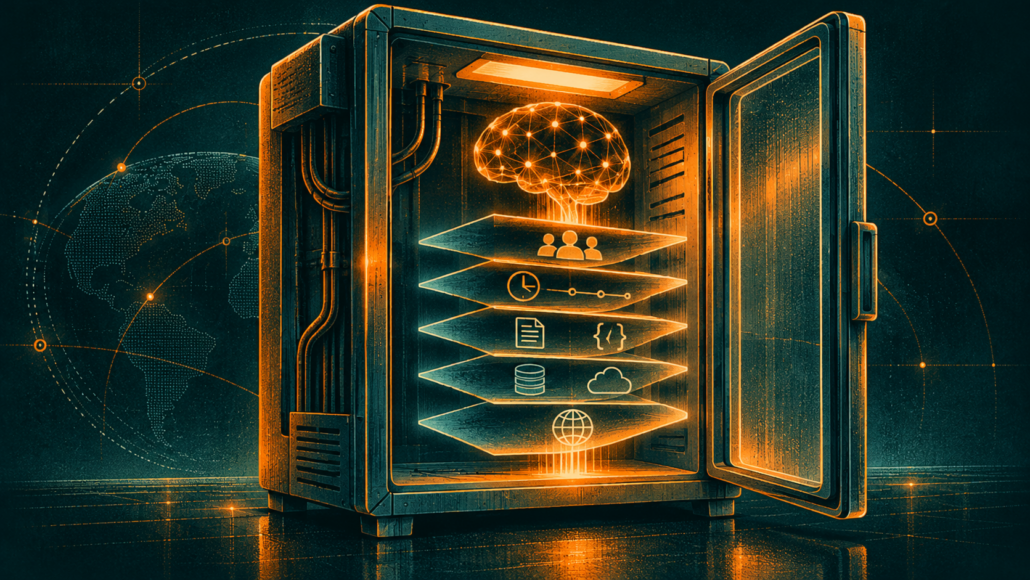
A five-layer context stack sits underneath any model, with your team’s operational knowledge at the top and current direct observation at the base. Models reason across the stack. They should not be mistaken for the stack itself.
Two things get special attention. The first is time. If the AI only knows the current state, it can answer the wrong question perfectly. A domain that looks harmless today may have resolved to phishing infrastructure three days ago.
The second is the data’s user manual: what each field means and where it came from. An API key tells the system where information lives; it doesn’t tell the system how to interpret what comes back.
How much does an AI SOC cost?
AI relocates the cost of security work. Headcount becomes compute spend: analyst time turns into software, infrastructure, model usage, and data access in some combination.
A twenty-minute investigation may take two, but leadership still has to ask what it costs at scale. Here is where the picture gets murky.
Security buyers know how to count endpoints and seats. Autonomous work is stranger. What is one investigation: three lookups or three hundred? What happens when every alert that once waited for an analyst is now investigated automatically? The user sees the same button either way.
Compare the economics of all three approaches and one principle holds: optimize for cost per defensible decision rather than cost per token. What drives consumption up, and how to keep it in check, is a longer conversation.
What does an AI SOC investigation look like in practice?
Consider a single alert. A medium-severity IAM alert lands in the queue. A user signs in to Microsoft 365, completes MFA, and the identity provider allows the session. The source IP and ASN are new to the organization, and the location is unusual. Travel or a consumer VPN could explain all of it. A busy SOC sees this every day.
Then the AI asks a better question: what is actually running on the host?
The answer changes the case. The same evidence, viewed with different intent, now supports a different decision for each team that touches the alert.
Triage: does this deserve an escalation? A successful MFA login from a new IP is easy to dismiss. A successful login from infrastructure serving credential-attack tooling is not. It still doesn’t prove compromise, but it moves the alert out of the routine-risky-login bucket. Decision: escalate.
DFIR: what happened around the login? Were there failed attempts before the session? Did the user authenticate elsewhere from the same infrastructure? Were new sessions, OAuth grants, or mailbox rules created afterward? The responder needs the state of the account and the infrastructure during the incident window, not what either looks like now. Decision: build the timeline.
CTI: is this host part of something larger? Similar infrastructure appears across regions and providers. That could mean a shared operator, a rented service, or several unrelated actors using the same kit. The evidence doesn’t settle it, so attribution stays open. Decision: expand the infrastructure, preserve uncertainty.
Detection engineering: what can we detect next time? Blocking one IP solves one IP. The durable signal is the service itself and the traits that set it apart from ordinary hosts. Decision: detect the pattern, not the address.
None of these required a different version of reality. They required the same evidence, viewed with different intent. A good context layer gives an AI SOC enough truth to ask the right next question.
Build the context layer first
The AI SOC will not arrive in one form. Some teams will build it, some will assemble it, some will buy it. Most will probably do a mixture over time. These implementation decisions matter, but they are not the foundation.
Before choosing models, agents, or vendors, ask harder questions about what sits underneath them. Can the system reconstruct what happened, and not only what is happening now? Can you explain what each decision costs?
The smartest model in the world is still limited by what it can see, what it understands, and what it has been taught to do. Build the context first, so every team can make a decision it can defend.
Download Building an AI SOC to read the full context stack, pricing comparison, and worked example end to end.