






Executive Summary
- Censys ARC researchers tested nginx2root, the five code execution nginx vulnerabilities disclosed today, in our own lab.
- We reached the CVE-2026-123007 corrupted flow-control state with a compact cleartext HTTP/2 test and vulnerable and patched packet captures: github.com/Censys-Research/nginx2root
- We also reproduced three independent use-after-free conditions across the other attack paths. Each has different build and crash evidence.
- Defenders can use this to study the bug and test patches without generating the 60–119 GiB of traffic reported for Rapid7’s later crash and remote code execution (RCE) stages.
- Configuration determines reachability. Four configurations expose different attack paths: HTTP/2; HTTP/3 with upstream proxying; runtime Domain Name System (DNS) resolution with subrequests; and mail proxy authentication. Disabling HTTP/2 addresses only two of the five nginx CVEs.
- Censys is tracking live data on affected nginx instances on our public dashboard: nginx2root.censys.com/. Additional details about the vulnerabilities and how to measure your nginx exposure in Censys can be found in our Rapid Response advisory.
Background
On 18 November 2026, Xint disclosed five nginx vulnerabilities called nginx2root. Each vulnerability affects memory in an nginx worker process and requires a specific feature: HTTP/2, reverse proxying over HTTP/2 or HTTP/3, runtime DNS resolution with subrequests, or mail proxy authentication. Xint stated that any of these allows an unauthenticated attacker to run commands as the worker process, and that combining CVE-2026-123007 with a Linux kernel bug allows root access. Censys has not verified the kernel flaw or that exploit chain.
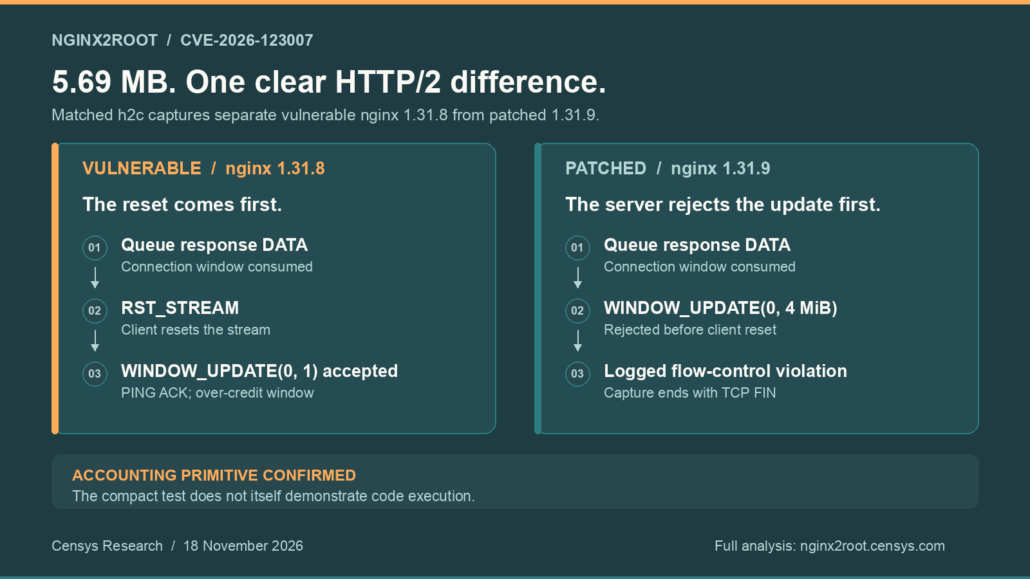
Censys researchers tested these issues in isolated labs. For CVE-2026-123007, we created a small test using cleartext HTTP/2 (h2c) that shows different responses between vulnerable nginx 1.31.8 and patched 1.31.9. The entire capture is 5.69 MB, allowing defenders to test patches and detections without generating the large traffic volume (60–119 GiB) reported by Rapid7. That test and further technical details are available here: github.com/Censys-Research/nginx2root. We also reproduced use-after-free conditions for three of the other four CVEs, though none resulted in remote code execution.
To fix these vulnerabilities, upgrade nginx Open Source to 1.30.7 or later (stable) or 1.31.9 or later (mainline), and restart the service. NGINX Plus users should update to 37.0.8.1 or 37.3.0.1. Disabling HTTP/2 only addresses two of the five CVEs, so full patching is required.
For additional guidance, see the Censys nginx2root Rapid Response advisory.
What Censys ARC confirmed
| CVE | Attack path | Result |
| CVE-2026-123007 | HTTP/2 flow control | Accounting error confirmed over h2c on 1.31.8; 1.31.9 rejected the sequence. No crash |
| CVE-2026-123633 | HTTP/2 with upstream proxying | Use-after-free and worker crash on the unmodified official 1.31.8 image; 1.31.9 did not crash |
| CVE-2026-123634 | Runtime DNS resolution with subrequests | Use-after-free confirmed under AddressSanitizer (ASAN), plus crashes on a custom debug build. No stock-image crash |
| CVE-2026-113425 | Mail proxy with auth_http | Stale-session crash on pristine 1.31.8, confirmed as a use-after-free under ASAN; 1.31.9 stayed running |
| CVE-2026-121810 | HTTP/3 with upstream proxying | Not reproduced |
Detection
Network detection requires inspection of cleartext HTTP/2 control frames, as TLS encryption hides them. Decrypted telemetry or cleartext h2c connections are necessary for payload signatures. Encrypted traffic still reveals volume and timing, but these indicators are not specific to these CVEs.
Flow-control operations occur in standard traffic. Actions like large WINDOW_UPDATE frames, stream resets, GOAWAY frames, or disconnected workers do not independently indicate exploitation. Effective detection relies on identifying specific frame sequences and timing, supported by server-side logs.
We developed candidate Suricata rules as part of this research. On Suricata 8.0.1, signature ID 9007015 fired exactly once on the real vulnerable h2c capture and produced zero alerts on the patched control. This validates the rule against that specific traffic pair, not as a general exploit detector.
The remaining detection rules are experimental. Sixteen synthetic test scenarios passed, while single-byte TCP segmentation revealed a gap in the raw-stream PCRE signatures. Rules for Rapid7’s bootstrap sequence remain untested on live traffic. These signatures detect specific frame patterns rather than memory corruption, and the rule set requires production validation across active sensors.
Host and application logging provide clearer context.
What security operations teams should do now
- Save nginx error logs, worker crash events, and HTTP/2 flow-control errors with timestamps and listener details.
- Alert on unexpected child processes or strange outbound network connections from nginx workers, treating them as high-priority security events.
- Match network alerts with your exact nginx package version, server configuration, and network path.
- Avoid assuming a compromise based only on crashes or resets, as basic service glitches can look similar.
What defenders should do now
1. Upgrade nginx: Move stable builds to 1.30.7+ and mainline to 1.31.9+. NGINX Plus users should update to 37.0.8.1 or 37.3.0.1. If using Linux distribution packages, ensure their advisories cover all five CVEs.
2. Restart service workers: Fully restart the nginx service after updating. A simple configuration reload does not replace the running binary in memory.
3. Audit high-risk configurations: Look beyond simple version banners. Check for active HTTP/2 and HTTP/3 listeners, dynamic resolver settings, request-driven proxying, subrequests, and mail proxy auth_http.
4. Apply targeted mitigations: If patching is delayed, disable HTTP/2 or HTTP/3 to mitigate protocol-specific paths. Restrict mail proxy traffic to trusted sources. (Note: mirror_request_body on does not fully resolve subrequest risks).
5. Prioritize exposed systems: Focus first on internet-facing HTTP/2 instances identified via search queries like the Censys host query, followed by version-hidden systems and internal proxies.
6. Monitor and retain logs: Watch for abnormal worker process activity and preserve relevant logs before routine rotations occur.
As of 2:00 p.m. Pacific Standard Time on 18 November 2026, the Censys ARC team was not aware of any reported in-the-wild exploitation, and none of the five nginx2root CVEs appeared in the CISA Known Exploited Vulnerabilities Catalog. That is a point-in-time absence of evidence, not proof that no attacks have occurred.
Appendix: narrow HTTP/2 triage queries
These queries search for HTTP/2 support and an affected CVE-2026-123007 nginx version in the Server header on the same endpoint. They also cover the overlapping CVE-2026-123633 version range, but do not check if required configurations are present.
Hosts:
host.services:(endpoints:(http.supported_versions="HTTP/2" and http.headers:(key="Server" and value=~"^nginx/((1\\.9\\.[5-9]|1\\.9\\.[1-9][0-9]+|1\\.[1-2][0-9]\\.[0-9]+|1\\.30\\.[0-6])|(1\\.31\\.[0-8]))([[:space:]].*)?$")))Web properties:
web.endpoints:(http.supported_versions="HTTP/2" and http.headers:(key="Server" and value=~"^nginx/((1\\.9\\.[5-9]|1\\.9\\.[1-9][0-9]+|1\\.[1-2][0-9]\\.[0-9]+|1\\.30\\.[0-6])|(1\\.31\\.[0-8]))([[:space:]].*)?$"))References
- Censys, nginx2root advisory: CVE-2026-123007, CVE-2026-123633, CVE-2026-123634, CVE-2026-121810, and CVE-2026-113425.
- Xint, “NGINX2Root: New Remote Code Execution Vulnerabilities in nginx Require Urgent Patching”, 18 November 2026.
- Xint, nginx2root disclosure site.
- nginx, Security advisories.
- nginx, Changes with nginx 1.30.7 and changes with nginx 1.31.9, 18 November 2026.
- Rapid7, “CVE-2026-123007: Critical nginx HTTP/2 Integer Underflow Leads to RCE (FIXED)”, November 2026, and public proof-of-concept repository.
- CISA, Known Exploited Vulnerabilities Catalog.