







Vulnerability Description
CVE-2026-76466 is a critical (CVSS v3.1 9.8, as scored by Cisco) remote code execution vulnerability in the database service of Cisco Expressway Series, which covers both Expressway-C (Core) and Expressway-E (Edge). An unauthenticated attacker with network access to the device can run arbitrary operating system commands as root. Cisco and CISA classify the weakness as use of hard-coded credentials (CWE-798).
According to NVD, “A vulnerability in the database service feature of Cisco Expressway Series could allow an unauthenticated, remote attacker with network access to a Cisco Expressway device to execute arbitrary operating system commands as root. This vulnerability is due to the use of persistent cookies. Additionally, there is insufficient validation of client certificates when the TLS Verify Mode is set to Enabled for clustering, which means that client certificates are not validated. An attacker with possession of the cookies could exploit this vulnerability by connecting to the database service and invoking specific remote procedure call (RPC) commands. A successful exploit could allow the attacker to execute arbitrary commands as root on the underlying operating system of an affected device.”
The preconditions required for exploitation are a release at or below X15.5.3 and a device configured in a cluster, per Cisco’s advisory. The NVD description and the CISA Known Exploited Vulnerabilities (KEV) catalog entry add a third condition: the attacker must hold the persistent cookies. Cisco states there are no workarounds.
Impact
F6 reports exploitation of one organization in which attackers gained root command execution on two internet-facing Expressway devices and then reached two further cluster nodes on its internal network. F6 says the attackers prepared custom Python scripts for network scanning, SMB, SQL Server, WinRM, and exploring GitLab repositories to exfiltrate credentials. Patching does not remove access an attacker already obtained, so treat a clustered Expressway that ran an affected release while reachable as potentially compromised. F6 identifies a nodeup 'wombat@127.0.0.1' entry in erlang.log as a connection matching the known exploitation mechanism, after which other logs should be checked to confirm compromise. Until the upgrade lands, F6 recommends restricting TCP ports 4371 and 4372 to the IP addresses of trusted cluster hosts. This is F6’s recommendation and not a Cisco workaround.
Details
| CVE | CVE-2026-76466, CVSS v3.1 9.8 (Critical), assigned by Cisco |
| Date of Disclosure | October 21, 2026 |
| Affected Assets | Cisco Expressway Core (Expressway-C) and Edge (Expressway-E), virtual and appliance, when configured in a cluster |
| Vulnerable Software Versions | X15.5.3 and earlier; X14 and earlier must migrate to a fixed release |
| PoC Available | F6 reports a public exploit appeared before the attacks it observed, giving no date or link; no public proof-of-concept repository has been identified |
| Exploitation Status | Added to the CISA Known Exploited Vulnerabilities (KEV) catalog on November 20, 2026 (remediation due November 23, 2026); F6 reports one in-the-wild incident, however Cisco states it has no direct evidence of active exploitation |
| Patch Status | Fixed in X15.5.20 or later (Cisco advisory published October 21, 2026); Cisco lists X15.5.21 as the first fixed release for a separate PHP vulnerability pair (CVE-2026-109618, CVE-2026-109619) affecting Expressway, so treat X15.5.20 as the minimum |
Censys ARC Perspective
Censys observes roughly 14,900 Cisco Expressway hosts exposed to the internet as of November 23, 2026. More than a third of those hosts report a build at or after the first fixed release, so a sizable share of the exposed population is already past the fix.
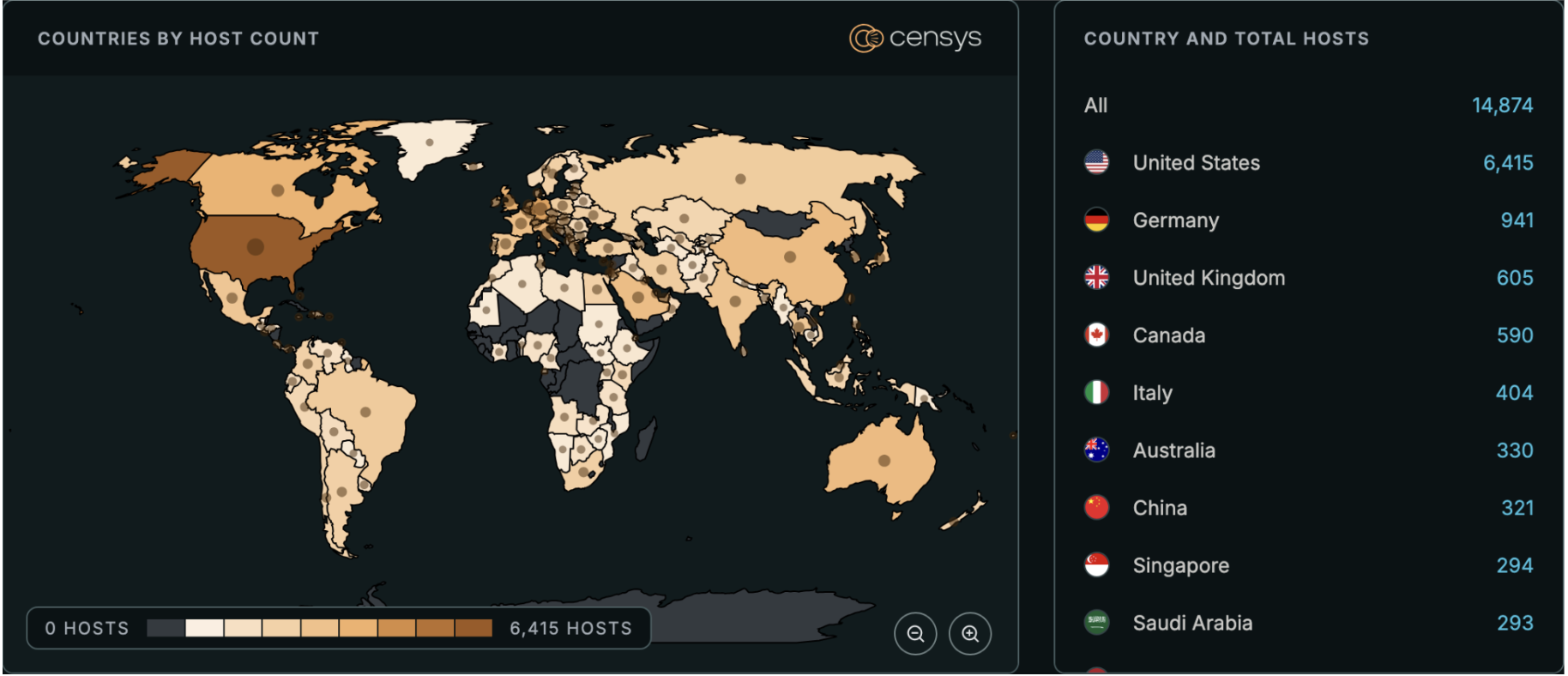
Hosts running Cisco Expressway, from a Platform host search.
Censys Queries
Platform: Found: 14,873 hosts
host.services.software:(vendor="cisco" and product="expressway")