







Vulnerability Description
CVE-2026-132825 is a heap buffer overflow in the Ruby interpreter’s string case conversion, scored CVSS v3.1 7.4 in the CVE record assigned by MITRE and rated Critical by the Ruby project, which tracks it as GHSA-34m4-m9fh-gqp5. The Ruby security team describes it this way: “Ruby has a one-byte heap-based buffer overflow in the case conversion of strings.” The overflow occurs for text in legacy single-byte encodings such as ISO-8859-1 and Windows-1252. It is one of seven Regexp and String flaws fixed in the same release; GHSA-87fm-7w84-j2px is a separate heap overflow in string case conversion with the same fixed builds.
The 7.4 score understates what the Ruby team describes. The Ruby security announcement states that changing the case of a crafted string may allow remote code execution, and that the team is aware of proof-of-concept code that triggers remote code execution in some scenarios. Exploitation requires an affected Ruby and an application that changes the case of attacker-supplied text in a legacy encoding. The announcement names no products and no methods. Veria Labs identifies the flaw by its GHSA ID and does not cite the CVE. It lists upcase, swapcase, downcase(:fold), and casecmp? as the triggering methods, says UTF-8 strings are not affected, and reports that default Ruby on Rails and classic-style Sinatra applications meet the condition while other frameworks and plain Rack do not by default.
Impact
No public exploit code yet demonstrates what the overflow achieves, so the consequence rests on the Ruby team’s statement that remote code execution is possible in some scenarios. Code running inside a Ruby application runs as that application and reaches what it holds: database credentials, session signing keys, and the tokens it uses to call other services, which extends the exposure to everything those secrets authenticate to. The fix is in the interpreter, so upgrading gems or frameworks does not remediate, and software that bundles its own Ruby, such as GitLab, needs the vendor’s release. Upgrade Ruby and restart the application, and treat one that was reachable while unpatched as exposed: review it for signs of use, and rotate its stored secrets if it shows any.
Details
| CVE | CVE-2026-132825 (assigned by MITRE), CVSS v3.1 7.4 (High); rated Critical by the Ruby project |
| Date of Disclosure | November 18, 2026 (Ruby announcement); November 19, 2026 (NVD) |
| Affected Assets | The Ruby interpreter and software that bundles it; Veria Labs reports default Ruby on Rails and classic-style Sinatra applications as reachable |
| Vulnerable Software Versions | Ruby 3.3.13 and earlier, 3.4.0 through 3.4.12, and 4.0.0 through 4.0.9; the vendor states no lower bound, Veria Labs says the flaw dates to Ruby 2.4.0, and 3.2 and older are end of life with no fix |
| PoC Available | Yes, privately: the Ruby team says it is aware of proof-of-concept code that triggers remote code execution in some scenarios, while a public repository holds crash reproducers only; Veria Labs says it will publish its own about a week after its page went up |
| Exploitation Status | No exploitation in the wild reported as of November 19, 2026 |
| Patch Status | Fixed in Ruby 3.3.14, 3.4.13, and 4.0.10, released November 18, 2026 |
Censys ARC Perspective
Censys observes roughly 3.8 million web properties running Rails, GitLab, Redmine, Mastodon, WEBrick, or GitHub Enterprise Server, about 3.7 million of them detected as Ruby on Rails. The Ruby version is not resolvable for Rails, Redmine, or Mastodon, so the share on an affected Ruby cannot be measured for them, and a property detected as Rails may already be on a fixed release.
Censys can read the Ruby version for WEBrick servers. Of roughly 4,500 WEBrick hosts, 285 report a Ruby on a branch the Ruby team still patches, all of them affected, and about 2,000 report an end-of-life Ruby from 2.4 through 3.2, which will not receive a fix. None of the WEBrick servers Censys has scanned reports a fixed release yet. Figures cover internet-reachable instances as of November 19, 2026.
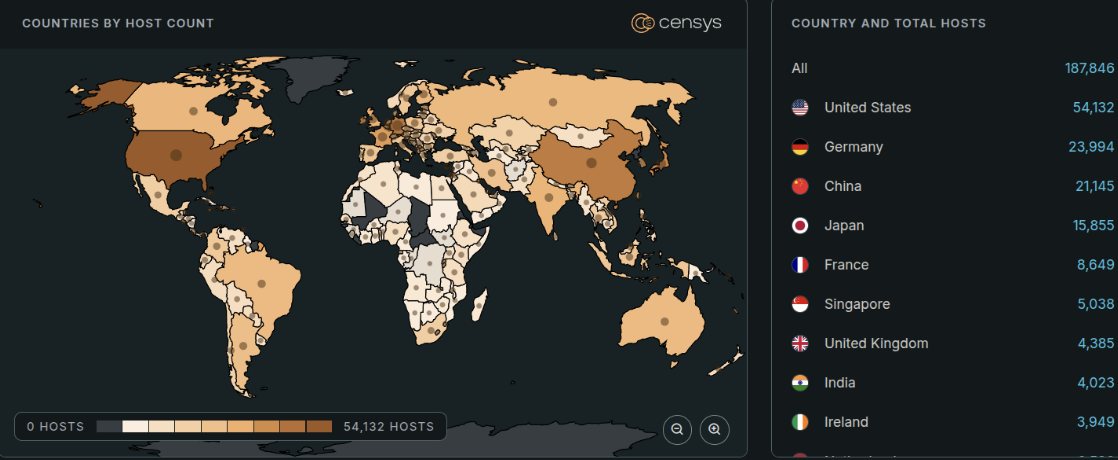
Hosts running Rails, GitLab, Redmine, Mastodon, WEBrick, or GitHub Enterprise Server, from a Platform host search. A host is one IP address, so this count is lower than the web property figure above, which counts every hostname and port.
Censys Queries
Platform: Found: 3,810,340 web properties
(web.software:(product={"gitlab","redmine","webrick","mastodon","rails"}) or web.software:(vendor="github" and product="enterprise")) and not labels:"HONEYPOT"
ASM:
host.services.software:(product={"GitLab","Gitlab","gitlab","Redmine","redmine","WEBrick","Mastodon","rails"}) or host.services.software:(vendor="GitHub" and product="Enterprise") or web_entity.instances.software:(product={"GitLab","Gitlab","gitlab","Redmine","redmine","WEBrick","Mastodon","rails"}) or web_entity.instances.software:(vendor="GitHub" and product="Enterprise")