





Vulnerability Description
CVE-2026-123890 is a critical, unauthenticated authentication bypass (CVSS v3.1 9.8) in the VMware Directory Service of VMware vCenter. The CVE record describes it as “VMware vCenter contains an authentication bypass vulnerability in the VMware Directory Service,” and Broadcom’s advisory VMSA-2026-0009 says an attacker with network access to vCenter may exploit the issue to bypass authentication. Broadcom names no port or protocol, lists no workaround, and credits Mandiant with the report. The same advisory covers four other CVEs, CVE-2026-123891 through CVE-2026-123894, in SDDC Manager and VMware Tools for Windows. This advisory covers only the vCenter flaw.
The Google Threat Intelligence Group (GTIG) and Mandiant describe the mechanism in ARMORY CASTLE Exploits vSphere. They call it “an unauthenticated Secure Remote Password (SRP-6a) session key disclosure vulnerability over Distributed Computing Environment/Remote Procedure Calls (DCE/RPC)” in the vmdird service, exposed on TCP port 2012, that produces “a remote authentication bypass which creates an authenticated session established as administrator@vsphere.local.”
CVE-2026-59309 is an earlier vCenter directory service flaw, disclosed on July 29, 2026. Broadcom’s FAQ calls CVE-2026-123890 “a new and distinct issue” from it. GTIG says the two overlap in how the attacker obtains the shared session key without knowing the password, but differ in several key ways. The vCenter GTIG saw exploited was already patched against CVE-2026-59309, so patching for that CVE does not address this flaw.
In the intrusion GTIG describes, the actor reached the vCenter by moving laterally from a compromised BeyondTrust Remote Support device through internal Linux appliances. The BeyondTrust compromise is covered in ARMORY CASTLE Exploits BeyondTrust.
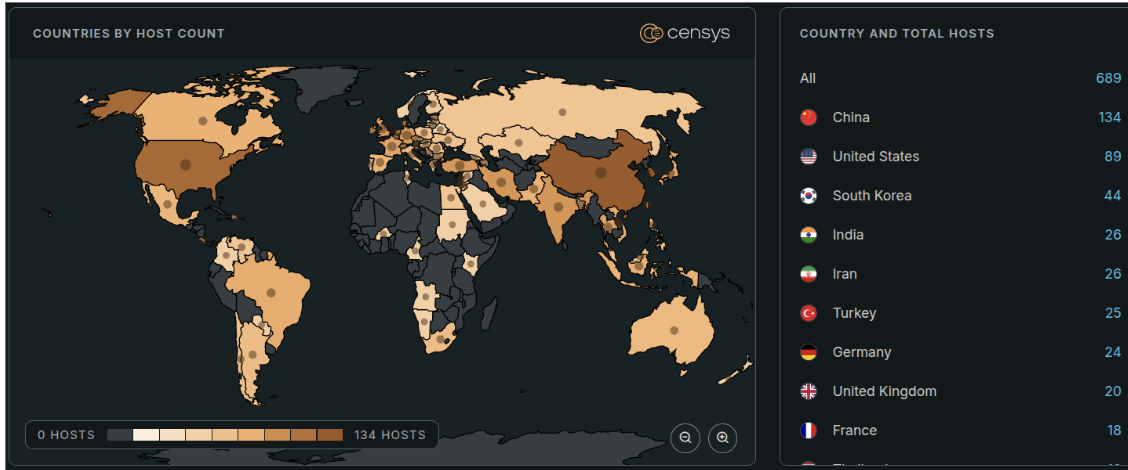
Hosts running VMware vCenter, from a Platform host search. A host is one IP address, so this count is lower than the web property count under Censys Queries, which counts every hostname and port.
Impact
GTIG observed its exploit utility, BONESAW, create an SSO administrator account on a vCenter and exfiltrate and parse the directory database. GTIG describes BONESAW as also able to extract the Security Token Service SAML private signing key and forge administrative SAML assertions.
GTIG reports that the actor deployed a second utility, SAWSNAKE, shortly after BONESAW ran and later deleted it and its output files. GTIG describes SAWSNAKE as able to extract identity provider signing keys and as enabling Golden SAML attacks, which let an actor forge authentication tokens, bypass MFA, and impersonate any user. GTIG does not say whether the signing key was taken in this intrusion.
The actor also enabled SSH on the vCenter appliance through its management API, extracted the vCenter master symmetric key and the PostgreSQL database credentials, and disabled SSH again immediately afterward. GTIG further reports the actor adding an SSH public key to the root account on an ESXi host and extracting files from a guest VM’s disk, so the exposure extends to the managed ESXi hosts and the virtual machines on them.
A vCenter that an attacker could reach while it was unpatched needs review for those changes whatever its current patch state, because patching does not remove accounts, keys, or access an attacker already created. Because the actor turned SSH off after use, check history as well as current state: new SSO administrator accounts, changes to SSH access made through the appliance management API, and unexpected SSH public keys on ESXi hosts. Mandiant’s VCSA Hardening and Logging Tool and the vSphere and BRICKSTORM defender guide cover hardening and logging going forward.
Details
| CVE | CVE-2026-123890, CVSS v3.1 9.8 (Critical), assigned by the VMware CNA |
| Date of Disclosure | November 19, 2026 |
| Affected Assets | VMware vCenter, including the vCenter in VMware Cloud Foundation, VMware vSphere Foundation, Telco Cloud Platform, and Telco Cloud Infrastructure. SDDC Manager and VMware Tools for Windows are covered by separate CVEs in the same advisory. |
| Vulnerable Software Versions | vCenter 9.1.x before 9.1.1.0200, 9.0.x before 9.0.2.0200, 8.0 before 8.0 U3m, and VCF vCenter 5.x before 5.2.5, as Broadcom’s matrix lists it. Telco Cloud Platform 3.0, 4.x, 5.0.x, 5.1.x, and 5.2, and Telco Cloud Infrastructure 3.0, as listed by Broadcom. Broadcom’s matrix and FAQ list vCenter 7.0 as impacted with no fixed version; the CVE record does not list 7.0. |
| PoC Available | No public exploit code has been identified for this CVE. Public proof-of-concept code exists for the related CVE-2026-59309, the directory service authentication bypass from VMSA-2026-0006. Public exploit code also exists for CVE-2026-59310, the Syslog directory traversal from the same bulletin, along with a tool that combines the two. |
| Exploitation Status | GTIG and Mandiant report exploitation in early September 2026 by the suspected PRC-nexus actor ARMORY CASTLE, in an intrusion they describe. This is a single report, from the organization that also reported the flaw to Broadcom. Broadcom’s advisory does not state whether the flaw is being exploited. |
| Patch Status | Fixed in vCenter 9.1.1.0200, 9.0.2.0200, and 8.0 U3m, per VMSA-2026-0009, published November 19, 2026. VCF 5.x customers apply vCenter 8.0 U3m through the asynchronous patching process in Broadcom KB 88287, which says VCF 5.2 and 5.2.1 use the in-product Flexible BOM and not the Async Patch Tool, and update SDDC Manager to 5.2.5. Telco Cloud Platform and Infrastructure are fixed by vCenter 8.0 U3m per Broadcom KB463116. No workaround is listed. vCenter 7.0 reached end of general support on October 2, 2025, and customers with an extended support contract request patches through Broadcom Support. |
Censys Queries
Platform: Found: 1,194 web properties
web.software:(vendor="vmware" and product="vcenter")
ASM:
host.services.software:(vendor="VMware" and product="vCenter") or web_entity.instances.software:(vendor="VMware" and product="vCenter")