






Update 2, October 23, 2026: This advisory has been updated. Changes include: refreshed Censys host and web property counts (which reflects continued improvements to our PHP detection logic), a revised PoC Available? assessment, and additional, conflicting reporting on the scale of in-the-wild exploitation.
Update, October 22, 2026: This advisory has been updated since our initial publication on October 21, 2026. Changes included: new reporting on exploitation activity, including a confirmed attempted exploitation of CVE-2026-109618 observed by VulnCheck’s sensor network, alongside conflicting reports from other sources; disclosure that VulnCheck holds a privately available working exploit for CVE-2026-109618; and more precise per-branch vulnerable version ranges.
(Updating LIVE) php2shell – Censys ARC Tracking Dashboard
>>> Find live updates global exposure to php2shell. <<<
CVE-2026-109618 and CVE-2026-109619 are two critical memory-corruption flaws in PHP, each rated CVSS 9.2 by the PHP project, that allow an unauthenticated remote attacker to execute code on a PHP web server. Both affect any PHP installation serving web requests, including Apache with mod_php, PHP-FPM, php-cgi, FrankenPHP, and LiteSpeed. Researchers have taken to calling the pair “php2shell.”
CVE-2026-109618 is an out-of-memory handling flaw. According to the PHP security advisory, “PHP uses longjmp() for out-of-memory (OOM) errors to exit the current context and abort handling of the request. In some contexts, request memory is temporarily reachable before it is fully initialized. If any allocation fails at that point, PHP does not properly account for the early exit and leaves the request memory in an invalid state.” A request can be crafted to drive PHP to that out-of-memory point during multipart body parsing while staying within configured limits; on Apache mod_php this happens before any application code runs.
CVE-2026-109619 is a use-after-free flaw. According to the PHP security advisory, “PHP contains various global state, such as error, session, object and extension state that is retained by a worker but points to memory owned by one request.” Exploitation requires a producer that leaves request-owned state behind, and a consumer that acts on it in a later request handled by the same worker.
PHP validated full remote code execution against Apache mod_php for CVE-2026-109618. For CVE-2026-109619, PHP validated remote code execution against mod_php specifically on PHP 8.5 with the fatal_error_backtraces setting enabled, and against both mod_php and PHP-FPM through the session upload progress feature, which is enabled by default.
We currently detect 4,184,559 hosts and 67,597,101 web properties running PHP, based on the query below. These counts continue to rise as we expand our PHP detection coverage; they reflect better visibility into an already-large population, not a sudden change in how much PHP is actually exposed.
Details
| Field | Description |
|---|---|
| CVE-ID | CVE-2026-109618 and CVE-2026-109619, each CVSS v4.0 9.2 (Critical), scored by the PHP project. Neither has an NVD CVSS score published as of October 23, 2026. |
| Date of Disclosure | PHP gave advance notice on October 20, 2026, and published fixes on October 21, 2026. NVD entries are not yet published as of October 23, 2026. |
| Affected Assets | Any PHP installation serving web requests: Apache with mod_php, PHP-FPM, php-cgi, FrankenPHP, and LiteSpeed. PHP considers mod_php the highest-risk deployment for both flaws. |
| Vulnerable Software Versions | 8.2.0 through 8.2.34, 8.3.0 through 8.3.35, 8.4.0 through 8.4.26, 8.5.0 through 8.5.11. PHP 7.4, 8.0, and 8.1 are also affected and received source-only backports, with no compiled release. PHP 5.4 through 7.3 are end of life and have no fix available. |
| PoC Available | Yes. VulnCheck holds a working, non-public exploit for CVE-2026-109618. A number of public repositories have also surfaced; most are unverified, but one actively developed repository now credibly claims an ASLR-bypassing remote exploit under a realistic production configuration. See PoC Available? below. |
| Exploitation Status | Not confirmed in CISA’s Known Exploited Vulnerabilities catalog as of October 23, 2026. Reporting on exploitation scale conflicts: Amazon describes broad in-the-wild exploitation, while Dataminr assesses observed activity as still mostly scanning and fingerprinting. See Exploitation Status below. |
| Patch Status | Fixed in PHP 8.2.35, 8.3.36, 8.4.27, and 8.5.12, released October 21, 2026. |
Affected Assets
PHP’s advisory states that any installation serving web requests is affected, “including but not limited to” Apache with mod_php, PHP-FPM, php-cgi, FrankenPHP, and LiteSpeed. PHP rates mod_php as the highest-risk configuration for both flaws because the vulnerable code path runs before any application code.
PHP 8.2.0 through 8.2.34, 8.3.0 through 8.3.35, 8.4.0 through 8.4.26, and 8.5.0 through 8.5.11 are fixed in this release. PHP 7.4, 8.0, and 8.1 no longer receive compiled builds; PHP published source-only backports for those three branches. PHP 5.4 through 7.3 are end of life with no fix path at all; those installations must be upgraded to a supported branch. NVD has not yet published an entry for either CVE as of October 23, 2026.
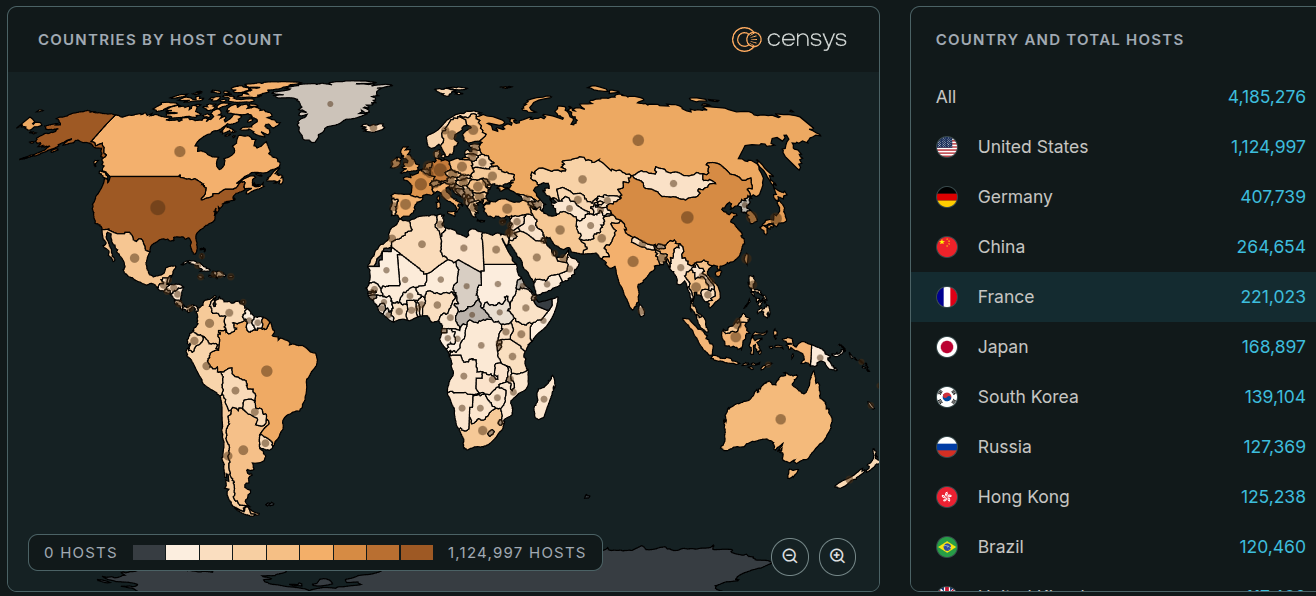
We currently detect 4,184,559 hosts and 67,597,101 web properties running PHP, based on the query below. As with our October 22 update, these totals are higher than our initial report; that continues to reflect ongoing improvements to our PHP detection logic that broaden coverage of the existing population, not a change in the scope of what’s affected.
Censys Query
We currently detect 4,184,559 hosts and 67,597,101 web properties running PHP, based on the following query. These two counts aren’t additive: a single host can run PHP on multiple ports, and each is counted separately in the web property total.
(host.services.software: (vendor="php" and product="php")) and not labels:"HONEYPOT"
(web.software: (vendor="php" and product="php")) and not labels:"HONEYPOT"
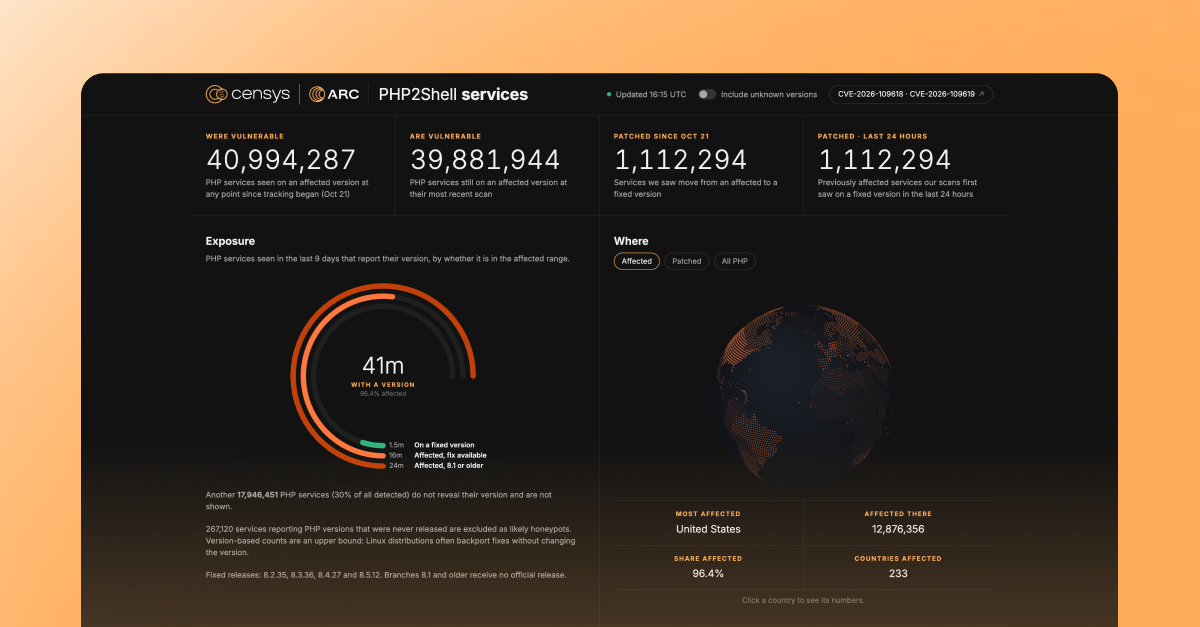
Censys also maintains a public PHP2Shell dashboard that tracks internet-facing PHP services by whether their reported version is fixed or affected, updated hourly from Censys scan data, with breakdowns by country, network, and PHP version, and a day-by-day view of patching progress.
PoC Available?
Yes, for CVE-2026-109618. VulnCheck reports that it holds “a weaponized exploit for CVE-2026-109618,” not publicly released. VulnCheck says the exploit chains a confirmed memory leak into remote code execution across PHP 8.4.10 through 8.4.26 with no modification required, working on x86-64 with ASLR enabled and display_errors disabled, which it describes as the typical production configuration. VulnCheck’s public write-up states, as of October 22, that on ARM64 the memory leak works but the RCE step does not; that status appears to be evolving quickly and may no longer be current.
VulnCheck says hundreds of public proof-of-concept repositories for CVE-2026-109618 appeared following reports that word of the vulnerabilities’ existence leaked ahead of the planned patch release, and initially assessed that “only a very small number have been legitimate exploits, and none independently bypass ASLR on x86-64 systems.” That assessment is now out of date: at least one publicly available, actively developed exploit repository claims a working, fully remote HTTP RCE against stock PHP 8.4.26 running the official php.ini-production configuration (display_errors=Off, ASLR enabled), reporting consistent success against an unmodified official Apache/PHP container image and adding aarch64 support alongside x86-64.
VulnCheck reports no working exploit specific to CVE-2026-109619. It says it independently reproduced both vulnerabilities and, in its own testing, achieved code execution on ARM64 systems and on x86 systems without ASLR, without differentiating which of the two CVEs that result applies to.
Exploitation Status
The earliest observed exploitation attempt predates public disclosure. Amazon’s threat intelligence team reports that its MadPot honeypot network recorded a CVE-2026-109618 exploitation attempt on October 17, 2026, four days before the embargo on the PHP advisories lifted, originating from an IP address associated with a commercial anonymization network. Amazon says it is unclear how the actor obtained exploit information while the vulnerability was still under embargo, and that it is unclear whether the attempt would have succeeded against a real-world system. Amazon reports additional proof-of-concept activity against MadPot beginning within hours of the October 21, 2026 public release, from multiple apparently distinct sources, and states that CVE-2026-109618 “is now being broadly exploited in the wild.”
VulnCheck’s sensor network separately recorded one unsuccessful exploitation attempt against CVE-2026-109618, from a China-based IP address, that attempted to drop a webshell via a server-side session file, plus a probe referencing both CVE-2026-109618 and CVE-2026-109619 with no exploitation attempt. VulnCheck states it expects broader exploitation attempts going forward. watchTowr reports exploitation attempts against both CVEs observed through its own honeypot network as of October 21, 2026.
Reporting on the scale of exploitation conflicts. Where Amazon describes CVE-2026-109618 as now broadly exploited, Dataminr’s TRACE team assesses that observed activity remains mostly scanning and fingerprinting, with non-working exploit attempts and no confirmed compromises as of October 22, 2026. The Canadian Centre for Cyber Security similarly reports no active exploitation identified, as of its October 21, 2026 alert. Neither CVE is listed in CISA’s Known Exploited Vulnerabilities catalog as of October 23, 2026.
Patch Status
PHP fixed both vulnerabilities in 8.2.35, 8.3.36, 8.4.27, and 8.5.12, released October 21, 2026, after advance notice to downstream maintainers on October 20, 2026, via its security advisories (CVE-2026-109618, CVE-2026-109619). PHP 7.4, 8.0, and 8.1 have source-only backports with no compiled build; applying them requires building PHP from source. PHP 5.4 through 7.3 are end of life and unpatched; those hosts need to move to a supported branch, since no fix exists for them on their current version.
Because VulnCheck’s sensor network recorded a live attempt to drop a webshell via a server-side session file targeting CVE-2026-109618, a host that was internet-reachable and unpatched before applying the fix warrants a compromise check independent of its current patch state, not just an upgrade. Review web server access logs for large multipart POST requests carrying a PHP_SESSION_UPLOAD_PROGRESS field alongside a PHPSESSID cookie, and inspect the PHP session storage directory for unexpected files.
References
- PHP: Security advisory, critical remote code execution vulnerabilities (vendor advisory and disclosure timeline)
- GHSA-w8hw-w9fx-j79w (CVE-2026-109618 technical detail and confirmed exploitation scenarios)
- GHSA-6wmf-4rv5-p3rp (CVE-2026-109619 technical detail and confirmed exploitation scenarios)
- PHP: Supported Versions (backport and end-of-life status by branch)
- VulnCheck: php2shell vulnerabilities (exploit availability, independent reproduction, and sensor-observed exploitation attempt)
- Amazon Threat Intelligence: PHP2Shell exploitation prior to public disclosure in MadPot (pre-disclosure and post-release honeypot-observed exploitation)
- BleepingComputer: Amazon says PHP2Shell exploitation began 4 days before patches (Dataminr’s conflicting assessment of exploitation scale)
- watchTowr: PHP RCE FAQ (honeypot-observed exploitation)
- Canadian Centre for Cyber Security: AL26-026 (national CERT assessment of exploitation status)
- Censys: PHP2Shell dashboard (live exposure and patching-progress tracker)