







CVE-2026-109390 is a pre-authentication, zero-click heap-based buffer overflow in AnyDesk’s session protocol, CVSS 9.8, that allows a remote, unauthenticated attacker to execute arbitrary code, demonstrated on Linux as command execution as root without the victim approving desktop control. The flaw, dubbed “AnyPwn” by the researchers who found it, lives in the handler for “mode-5” stream packets: the handler adds a fixed 16-byte header to an attacker-supplied payload length using 32-bit arithmetic with no overflow check, so a length near the maximum 32-bit value wraps the calculation to zero. A very small buffer is then allocated while the rest of the code continues to treat the object as the original, much larger size, and writing data into it corrupts adjacent heap memory.
A public proof-of-concept, published by V12 Security researcher Rick de Jager, leverages that corruption via a ROP chain to call the process’s own system() function and run an arbitrary command as root, before a user approves any connection. Exploitation requires reaching the AnyDesk listening service (anydesk --service, which runs as root on Linux) over a direct TCP connection rather than through AnyDesk’s relay infrastructure; the researchers separately triggered the vulnerable code path through relay connections using instrumentation, but did not demonstrate a full remote exploit chain over relays, so relay-based exploitation remains unproven.
V12 Security publicly announced the flaw on June 22, 2026, and AnyDesk acknowledged it the next day and fixed it in version 8.0.3, released June 23, 2026, though its own changelog describes the fix only as “Fixed a bug that could lead to a crash,” with no mention of its security impact. CVE-2026-109390 was published October 12, 2026, nearly four months after the fix shipped; it was assigned and scored by MITRE as the assigning CNA, and AnyDesk has still not published its own security advisory for the flaw.
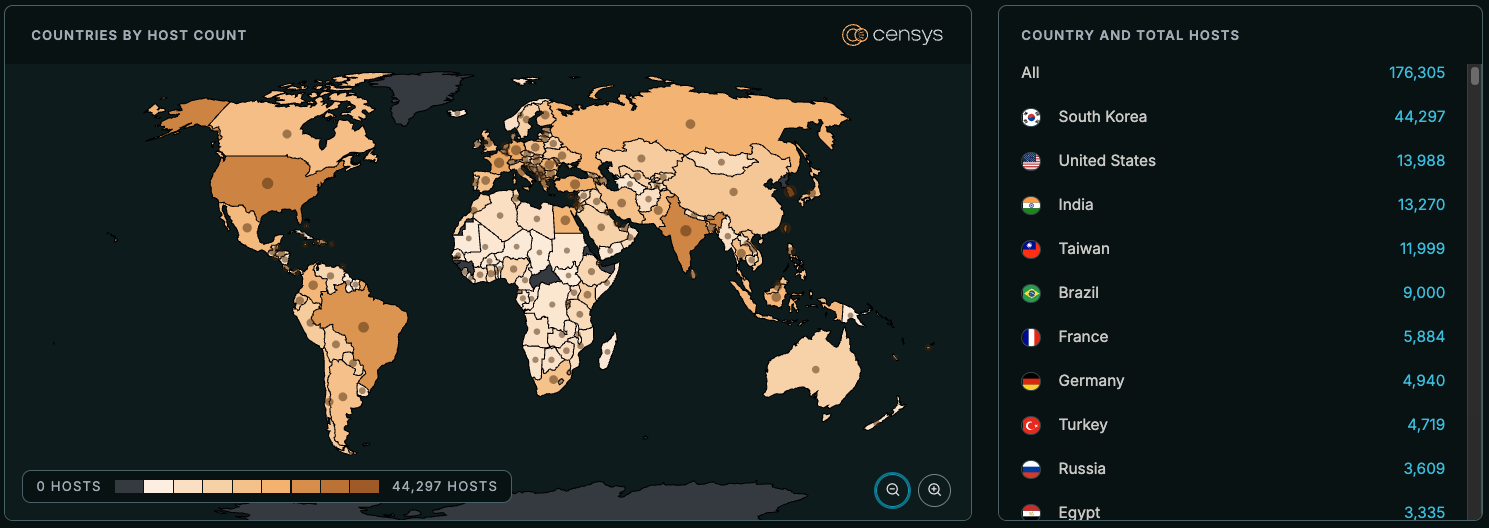
Censys currently detects 175,838 hosts exposing an AnyDesk service directly on TCP port 7070.
Details
| Field | Description |
| CVE-ID | CVE-2026-109390, CVSS 3.1 9.8 (Critical) |
| Date of Disclosure | Publicly announced by V12 Security on June 22, 2026; AnyDesk acknowledged the issue the next day. CVE-2026-109390 published October 12, 2026. Proof-of-concept exploit publicly released October 8, 2026. |
| Affected Assets | AnyDesk for Linux instances reachable over a direct TCP connection on the service’s listening port (default 7070). AnyDesk’s Windows and macOS clients are not affected. |
| Vulnerable Software Versions | AnyDesk for Linux 8.0.0 up to but not including 8.0.3, per the CVE record (CNA-submitted data; NVD has not yet independently analyzed it). |
| PoC Available | Yes. Published October 8, 2026 by V12 Security (researcher writeup and exploit code). |
| Exploitation Status | Not listed in the CISA Known Exploited Vulnerabilities (KEV) catalog, and no in-the-wild exploitation has been reported, as of October 13, 2026. |
| Patch Status | Fixed by AnyDesk in version 8.0.3 for Linux, released June 23, 2026. Current AnyDesk Linux release is 8.1.0. |
Affected Assets
AnyDesk’s Linux client and its anydesk --service process are affected when the service is reachable over a direct TCP connection, which by default listens on port 7070. AnyDesk told researchers the issue is “limited to direct connections on Linux” and that Windows and macOS are not affected, per The Hacker News. The researchers separately report triggering the vulnerable code path through AnyDesk’s relay infrastructure using instrumentation, but did not demonstrate a full exploit chain over relays.
The CVE record for CVE-2026-109390 lists AnyDesk for Linux 8.0.0 up to but not including 8.0.3 as affected. The public proof-of-concept specifically confirms exploitation against build 8.0.2, and The Hacker News reports the researchers separately consider it possible that 8.0.1 shares the same vulnerable code path, though exploitation of that specific build has not been confirmed.
Censys Query
We currently detect 175,838 hosts running AnyDesk with a service exposed on TCP port 7070, based on the following query below (note that this includes all versions and all operating systems). This figure represents total AnyDesk exposure on the default direct-connection port, not just vulnerable hosts.
host.services: (port: 7070 and software:(vendor:"anydesk" and product:"anydesk")) and not labels:"HONEYPOT"
PoC Available?
Yes. V12 Security published a working exploit, dubbed “AnyPwn,” on October 8, 2026, roughly three and a half months after publicly announcing the flaw and AnyDesk shipping a fix. The published exploit targets AnyDesk Linux build 8.0.2 specifically on x86_64 systems; the researchers note that other vulnerable builds would require different memory offsets to exploit. Exploitation depends on heap layout and is not guaranteed on every attempt; a failed attempt can crash the AnyDesk service rather than achieve code execution.
Exploitation Status
CVE-2026-109390 is not listed in the CISA Known Exploited Vulnerabilities (KEV) catalog, and the Censys ARC team is not aware of reports of in-the-wild exploitation, as of October 13, 2026. MITRE scored it CVSS 3.1 9.8 (Critical) as the assigning CNA; NVD’s own analysis is still pending as of October 13, 2026, so the score could be revised.
Patch Status
AnyDesk fixed AnyPwn in Linux version 8.0.3, released June 23, 2026, one day after V12 Security’s public announcement. AnyDesk’s own Linux changelog describes the fix only as “Fixed a bug that could lead to a crash,” with no security advisory or CVE identifier accompanying the release. Administrators should upgrade AnyDesk to the current Linux release.
Administrators unable to upgrade immediately should disable “Allow direct connections” in the AnyDesk client (Settings > Application > Connection > General, per AnyDesk’s settings documentation), which forces sessions through AnyDesk’s relay infrastructure instead of the direct-connection path the public exploit uses, and should restrict inbound access to the AnyDesk listening port (default TCP 7070) at the network perimeter.
References
- NVD: CVE-2026-109390 (CVE record, CVSS score, affected range)
- AnyPwn proof-of-concept and researcher writeup (V12 Security) (technical analysis and exploit code)
- The Hacker News: Researchers Publish Working Exploit for Pre-Auth AnyDesk Linux Flaw (disclosure timeline and vendor statement)
- AnyDesk Linux changelog (8.0.3 fix entry)
- AnyDesk downloads for Linux (current release)
- AnyDesk settings documentation (direct-connection mitigation)