






Description
FortiBleed is a recently disclosed credential-exposure campaign involving Fortinet FortiGate firewalls, SSL VPN gateways, and administrative management interfaces. The dataset was reportedly discovered in threat actor infrastructure and contains Fortinet firewall URLs, usernames, emails, plaintext passwords, and credential material associated with FortiGate environments. Researchers who reviewed the data reported roughly 73,932 unique firewall URLs across 194 countries and 21,632 affected domains, making this a large-scale perimeter credential exposure rather than a conventional software vulnerability.
Fortinet states that FortiBleed is not a newly disclosed Fortinet vulnerability and is not related to any recent incident or advisory. Based on Fortinet’s initial analysis, the activity appears to involve credential reuse from previous incidents and brute-force activity against devices with weak password hygiene and no multi-factor authentication. Other researchers reviewing the dataset reported that at least some records appear to originate from FortiGate configuration exports, but the exact method used to obtain that configuration data remains unconfirmed.
The risk is straightforward: FortiGate devices often sit at the edge of sensitive enterprise networks. If exposed VPN or administrative credentials are valid, an attacker may be able to authenticate remotely, access the firewall or VPN service, change configuration, create persistence, alter security controls, or pivot into the internal environment. The urgent question for defenders is not whether there is a new CVE to patch, but whether their Fortinet edge surfaces are publicly reachable, whether credentials tied to those surfaces have been exposed, and whether those credentials still work.
| Field | Description |
| Description | FortiBleed is a recently disclosed collection of credentials for Fortinet FortiGate firewalls and SSL VPN gateways that was discovered in a threat actor’s open directory. The dataset appears to have been assembled through a mix of credential reuse from prior Fortinet-related incidents, password-spraying attempts against exposed management and VPN interfaces, and offline cracking of credential material associated with FortiGate configuration data. Researchers who reviewed the dataset reported that some records appear to originate from device configuration exports, but the exact method used to obtain that configuration data remains unconfirmed. |
| Date of Disclosure | June 19, 2026 |
| Affected Assets | FortiBleed affects Fortinet FortiGate firewalls, SSL VPN gateways, and administrative management interfaces where valid credentials were exposed, reused, or cracked as part of the campaign. Fortinet states this is not a newly disclosed vulnerability and that the activity is not related to any recent incident or advisory. |
| Patch Status | There is no single patch for FortiBleed itself because the issue is credential exposure rather than a new product vulnerability. Fortinet recommends upgrading FortiGate appliances to current supported FortiOS releases, enabling PBKDF2-based administrator credential hashing, removing legacy password settings, rotating credentials, terminating active sessions, restricting administrative exposure, and enforcing MFA. |
| Recommendations | Check Hudson Rock for impact: Hudson Rock for FortiBleed exposure at https://www.hudsonrock.com/fortinet . Update FortiGate appliances: Upgrade to the latest versions of FortiOS (7.4, 7.6, or 8.0) and ensure credentials are rehashed using PBKDF2. Rotate credentials: Reset all passwords and terminate any active sessions. Remove management interfaces from public exposure: Restrict the administrative GUI and SSH management to trusted networks or an out-of-band management path. Do not leave the management interface reachable from the public internet. Enforce multi-factor authentication: Require MFA on SSL VPN and administrative logins so that a valid password alone is not sufficient to authenticate. |
Censys ARC Perspective
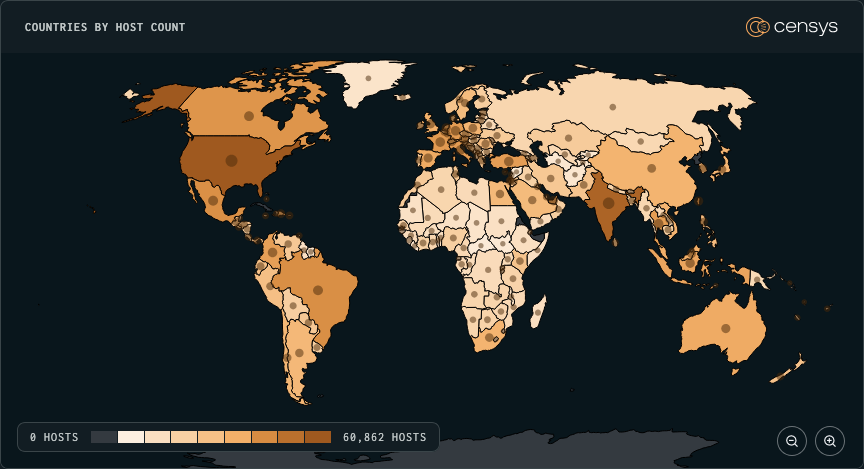
As of June 2026, Censys observes substantial internet-facing Fortinet exposure. FortiBleed is not something defenders can confirm by looking for a vulnerable software banner alone. The relevant exposure is a combination of reachable Fortinet edge services, credential validity, authentication controls, and whether management or VPN interfaces are accessible from the public internet.
For defenders, the highest-value workflow is to inventory exposed FortiGate management and SSL VPN interfaces, compare those assets against Fortinet and Hudson Rock impact guidance, rotate credentials, terminate sessions, require MFA, and remove administrative management from the public internet wherever possible.
Censys visibility is especially important here because credential compromise turns ordinary edge exposure into a much higher-risk condition. A FortiGate login page on the internet is not automatically evidence of compromise, but in the context of a large credential dataset, it becomes an asset that deserves immediate validation. Security teams should use Censys to find publicly reachable Fortinet services, prioritize assets with administrative interfaces exposed, confirm whether those systems are still intentionally internet-facing, and validate that compensating controls like MFA, trusted-host restrictions, and out-of-band management paths are in place.
References
- Fortinet, “Analysis of Reported Credential Compromise of FortiGate Devices”: https://www.fortinet.com/blog/psirt-blogs/analysis-of-reported-credential-compromise-of-fortigate-devices
- Fortinet PBKDF2 technical tip: https://community.fortinet.com/fortigate-3/technical-tip-enforcing-pbkdf2-as-hash-function-for-administrator-accounts-in-fortios-v7-2-11-and-later-220652
- DoublePulsar, “FortiBleed — 75k Fortinet firewalls have admin passwords cracked”: https://doublepulsar.com/fortibleed-75k-fortinet-firewalls-have-admin-passwords-cracked-60299faa65f8
- Hudson Rock / infostealers.com, “FortiBleed: 75,000 Fortinet Firewalls Compromised”: https://www.infostealers.com/article/fortibleed-75000-fortinet-firewalls-compromised-global-enterprises-exposed-claim-your-ethical-disclosure/
- Ars Technica, “Massive breach spills credentials for thousands of sensitive networks”: https://arstechnica.com/security/2026/06/massive-breach-spills-credentials-for-thousands-of-sensitive-networks/
- Hudson Rock FortiBleed exposure lookup: https://www.hudsonrock.com/fortinet
- Initial disclosure by Volodymyr Diachenko on LinkedIn: https://www.linkedin.com/posts/vdyachenko_massive-fortinetfortigate-bruteforceactive-activity-7471222472193830913-YBDi